Paper, or Screen?

Field Guide No. 10 · Journals & Planners
Paper, or
Screen?
Your phone will remind you. Only one of these will remember.
Nearly every lawyer now runs the calendar on a screen — the firm's system, synced to a phone, checked before the first coffee and after the last email. This guide will not talk you out of it. The calendar app does four things a book cannot, and they are listed below in full. What the guide argues is that a printed planner and a bound journal do three things the screen cannot, and that in a profession where a missed date is a claim and a lost note is a lost argument, those three are worth the price of a book. The Professional Weekly, the Large Monthly, the Pocket Weekly and the two ruled journals — the Large and the Desk — are Gallery Leather's, bound in Trenton, Maine. Here is the case for the screen, the case for the page, and which book for which job.
At a Glance
| The Screen | The Page | |
|---|---|---|
| Reminds you | Yes — on the phone, the watch and the laptop at once | No |
| Shared with the firm | Yes — the assistant, the docket clerk, the partner's trial date | Only if you hand it across |
| Searchable | In three seconds | By date, and by memory |
| The view | One day, very well. A month, behind "+3 more" | Thirty days across a spread. A working week in half-hours |
| Belongs to | The firm — the account goes when you go | You |
| As a record | Entries move or vanish without a mark | Sewn pages, in ink, in sequence |
| Fails when | The login lapses, the filter misfires, the battery dies | You leave it in a courthouse |
Neither replaces the other. The rest of this guide is about the division of labor.


Statement of Interest
We sell the five books argued for here and we do not sell a calendar app, so weigh what follows accordingly. The founder practiced law for twenty-six years and kept a paper planner the whole way through. Asked to name the day it saved him, he cannot. What it gave him, he says, was the ability to use his time more carefully: he knew at a glance what the schedule was and could see the demands it would make before they arrived. The same glance told him where he would be, and whether the flight, the hotel, and the people at the other end had been arranged. More than once it turned up a billable event that had been overlooked in the rush of the week and needed writing down and charging — the book, he says, more than paid for itself that way. And a phone number written in the margin that never made it into the office contacts was not lost. That is the entire personal testimony in this guide. The rest is in the footnotes.
The Argument
The Distinction, Plainly Stated
Three grounds on which a screen and a page are not the same instrument.
Ground I — The Screen Is an Alarm. The Page Is a View.
A day, at a glance. A month, behind a link.
A calendar app is built to interrupt you at the right moment, and it is very good at that. It is not built to show you the shape of March. Open the month view on a phone and a full day collapses to a line or two and a note reading "+3 more"; the conflicts are in there, but you find them one tap at a time. A printed month spread holds thirty days in one field of view — the closing, the brief due the Tuesday after it, the deposition wedged between — and a weekday ruled in half-hours shows what the hearing that ran long actually pushed. This is not a defect in the software. It is a decision about what a small screen is for. The book made the other decision.
Ground II — The Calendar Is the Firm's. The Book Is Yours.
The account goes when you go.
The calendar on your phone is almost certainly the firm's — an account the firm owns, on a device the firm manages. The practice-management guidance is plain about what that means: device-management software is installed so that a phone can be wiped, in part or in whole, when a lawyer leaves.1 Fifteen years of where you were and who you were with stay behind on a server you no longer have a login to. The planner on the shelf has no administrator. It is the one record of your practice that leaves the building in your own hand, in both senses.
Ground III — A Record Is Something You Can Be Asked For.
Sewn, dated, in ink. And producible.
Contemporaneous notes in a legal practice are quasi-evidentiary. They refresh a recollection years later; a record made when the matter was fresh can be read into evidence once memory has failed;2 they answer a fee dispute and, occasionally, a bar complaint. Two things follow. A bound book with sewn signatures cannot be quietly reordered or thinned, which is exactly the property that makes it believed. And a writing you use to refresh your memory on the stand can be demanded by the other side, inspected, and read to the jury.3 Keep the record knowing both. That is what a record is.
- Clio, How to Implement a Device Policy for Your Law Firm (updated Aug. 13, 2025), clio.com/blog/device-policy-for-law-firms (recommending mobile device management "so that the devices can be wiped in part, or in whole, if an employee leaves, or if they simply lose the device"). The firm's calendar account itself is the firm's to close; the wipe is what happens to the copy on your phone. ↩
- Fed. R. Evid. 803(5) (recorded recollection: a record "made or adopted by the witness when the matter was fresh in the witness's memory" that "accurately reflects the witness's knowledge" may be read into evidence when the witness "cannot recall well enough to testify fully and accurately"), law.cornell.edu/rules/fre/rule_803. State rules of evidence vary; most track the federal text. ↩
- Fed. R. Evid. 612(b) (when a witness uses a writing to refresh memory while testifying, "an adverse party is entitled to have the writing produced at the hearing, to inspect it, to cross-examine the witness about it, and to introduce in evidence any portion that relates to the witness's testimony"; for a writing used before testifying, the court decides whether justice requires it), law.cornell.edu/rules/fre/rule_612. ↩
Exhibit A — The Screen
The case for the app, made in full.
The calendar app wins on four counts, and it would be dishonest to pretend otherwise. It reminds you — at 8:45 for the 9:30, on the phone, the watch and the laptop at once, which no book has ever done. It is shared: your assistant sees it, the docket clerk sees it, and a collision with a partner's trial date surfaces before either of you books the flight. It is searchable, so "when did I last meet Harlan" takes three seconds instead of a shelf. And it reschedules without erasing — a hearing moved twice leaves no crossed-out mess. Docketing software goes further and calculates deadlines from the rules rather than from your arithmetic. The malpractice carriers have noticed; an application for coverage will ask what calendaring system you run, and the answer they like includes a computer.4
Some practice-management writers take the case all the way to its end: keep one calendar, keep it digital, and stop pretending a second one is a safeguard rather than a second place to be wrong.5 It is a serious argument, and the carriers who ask about "dual calendars" on the application do not entirely disagree with it, as Exhibit B explains. The app's one weakness is that its failures are silent. In 2017 a Florida appellate court declined to excuse a missed appeal deadline after a firm's spam filter deleted the order the firm needed to see; a "conscious decision to use a defective email system without any safeguards or oversight" was the firm's own problem, not the court's.6 A book fails loudly. It is on the desk or it is not.
Run the app. We do not sell one, and we would tell you to run it if we did.
- AThe reminder — 8:45 for the 9:30, on every device you own. The thing paper cannot do.
- BShared entry — the assistant's and the docket clerk's calendar are the same calendar.
- CSearch — every meeting with a name, in three seconds.
- D"+3 more" — the month view, where a full day collapses to a link.
| Made by | Microsoft, Google, Apple, or your practice-management vendor |
|---|---|
| Best for | The alarm, the shared calendar, the search, the rules-based deadline |
| Fails when | The login lapses, the filter misfires, or you leave the firm |
| Cost | Already paid for |
- DHIA, Potentially Reduce Professional Liability Insurance Premiums (June 2026), dhia.com/blog/potentially-reduce-professional-liability-insurance-premiums ("Carriers like to see dual calendaring solutions"); L Squared Insurance Agency, Legal Malpractice Insurers Require Law Firms to Have Docket & Calendar Procedures (July 2024), l2insuranceagency.com (many carriers require a dual-docket process, "at least one of the calendaring systems needs to be computerized"). Both are broker and agency statements about carrier practice, not carrier underwriting guidelines; read the application in front of you. ↩
- Wyoming State Bar, This Is Why I'm Single: You Should Only Have One Calendar for Your Law Firm (June 6, 2023), wyomingbar.org (arguing the dual-calendar practice is "a vestige from times past, when lawyers used paper calendars," and that two calendars create their own error: "if the time is recorded incorrectly on one calendar, which one is right?"). ↩
- Emerald Coast Utilities Authority v. Bear Marcus Pointe, LLC, 227 So. 3d 752, 756–57 (Fla. 1st DCA 2017) (affirming denial of relief where the firm's spam filter was configured to delete legitimate email without notice; no excusable neglect); reported in Debra Cassens Weiss, Law firm's automatic deletion of spam emails is blamed for failure to file timely appeal, ABA Journal (Sept. 28, 2017). The case concerns email rather than a calendar; it is cited for the principle, which travels. ↩
Exhibit B — The Page
The case for the book, and the one claim we won't make.
Start with what lawyers actually do. In Attorney at Work's 2024 survey of practicing lawyers, 84 percent said they take handwritten notes constantly or several times a day, and 86 percent reach for pen and paper rather than a tablet when they do; asked when, "to manage my schedule" was among the four answers given most. About 40 percent name the legal pad as their surface, 35 percent a bound notebook, planner or journal.7 The publication itself notes that a survey called "Analog Attorney" draws a self-selecting crowd, and it is right; read the numbers as a portrait, not a census. The portrait is still of a profession that never put the pen down.
Then take the carriers' view. Administrative errors — failing to calendar properly and failing to react to the calendar chief among them — account for close to a quarter of legal malpractice claims in the ABA's most recent profile, and have run between a fifth and a third of claims across editions of it, whatever software the profession bought.8 The carriers' answer is redundancy, but of a particular kind. A second calendar earns its keep only if it is kept independently — entered from the scheduling order itself, never copied from the first calendar, ideally by a different hand.9 A printed planner filled in from the order is that second system. A screenshot of the app is not. And the second system does not need to be switched on, signed into, or backed up.
Now the claim we will not make. The most repeated argument for paper is that writing by hand makes you remember better. A 2014 study out of Princeton and UCLA said so, and it has been quoted at every keyboard since. Two direct replications — Kent State in 2019, Tufts in 2021 — found small effects that did not reach significance, or none at all.10 Handwriting may still help you think; the evidence that it helps you remember is thinner than the headlines. Buy the book for the view, the record and the ownership. If it also improves your memory, treat that as a gift, not a warranty.
- AThe month spread — thirty days in one field of view, nothing behind a link.
- BHalf-hour lines, Monday through Friday, 7 AM to 7:30 PM, each one timed — the Professional's working week, cut the way a practice is cut. Saturday and Sunday share a column of plain lines.
- CSewn signatures — pages stay in the order you wrote them. A record that cannot be quietly thinned.
- DThe ribbon — back to this week without looking. The smallest reason the book is faster than you expect.
| Made by | Gallery Leather, Trenton, Maine — Spanish full-grain leather, Korean book block, assembled in Maine |
|---|---|
| Best for | The view, the second calendar, the record you keep |
| Fails when | You leave it behind — which is what the printed Personal Data page inside the journals is for |
| Guarantee | The maker's, for life, on construction; our Thirty-Day Assurance on top |
- Joan Feldman, Lawyers' Note-Taking Habits: Analog Attorney Survey Results, Attorney at Work (Sept. 3, 2024), attorneyatwork.com/analog-attorney-survey-results (84% handwrite notes "constantly" or "several times a day"; 86% choose pen and paper over e-tablets; "almost 40%" a legal pad, 35% "a paper notebook, planner or journal"; "to manage my schedule" among the top four occasions). More than 120 respondents, spring 2024, most in firms of one to five lawyers; the article's own caveat is that the survey's title "may have been self-selecting." ↩
- ALPS Insurance, Safeguarding Your Practice: What Current Malpractice Trends Are Telling Us About Managing Risk (July 23, 2026), alpsinsurance.com/blog (summarizing the ABA Standing Committee on Lawyers' Professional Liability, Profile of Legal Malpractice Claims 2020–2023 (2024): administrative errors "such as failing to calendar properly and failing to react to the calendar" now account for "nearly 25% of all claims," and calendaring mistakes "remain a primary cause of claims despite widespread adoption of legal technology"). The profile appears roughly every four years; the administrative-error share has run between roughly a fifth and a third of claims across editions. ↩
- ALPS Insurance, The False Sense of Security that Comes with Redundant Calendaring Systems (Mar. 7, 2024), alpsinsurance.com/blog (redundant calendars — "anything from a digital backup to a Day-Timer pocket calendar" — earn their value only "when they are created independently from the primary master calendar": e.g., the lawyer keeps Outlook, a secretary keeps "a separate paper calendar," both from original documents, with "no copying of critical deadlines off of the other's calendar"). But see Wyoming State Bar, supra note 5. ↩
- Pam A. Mueller & Daniel M. Oppenheimer, The Pen Is Mightier Than the Keyboard: Advantages of Longhand Over Laptop Note Taking, 25 Psychol. Sci. 1159 (2014). But see Kayla Morehead, John Dunlosky & Katherine A. Rawson, How Much Mightier Is the Pen than the Keyboard for Note-Taking? A Replication and Extension of Mueller and Oppenheimer (2014), 31 Educ. Psychol. Rev. 753 (2019) (direct replication; "performance did not consistently differ between any groups"; meta-analysis of direct replications "revealed small (nonsignificant) effects favoring longhand"); Heather L. Urry et al., Don't Ditch the Laptop Just Yet: A Direct Replication of Mueller and Oppenheimer's (2014) Study 1 Plus Mini Meta-Analyses Across Similar Studies, Psychol. Sci. (2021) (145 Tufts undergraduates; no significant difference between handwritten and typed notes on immediate performance). ↩
Exhibit C
The Bench, the Reporter, the Circuit
Three places the legal system itself keeps the paper — and what happened the one time a famous lawyer didn't.
The Bench
1,585 boxes. Open to anyone who asks.
Justice Harry Blackmun took handwritten notes at oral argument, case after case, for the twenty-four years he sat — counsel's name, the minute the argument began, a grade for the advocate, all on lined paper. Those notes are now in the Manuscript Division of the Library of Congress, in a collection of 1,585 boxes that joined the papers of thirty-eight other justices, and scholars read them to learn how the Court actually worked.11 The Court recorded the arguments too. It is the notes historians go to.
The Reporter
Ten years, by statute.
Federal law does not trust the transcript alone. The court reporter certifies the original notes — shorthand or otherwise — and files them with the clerk, who must keep them in the public records of the court for not less than ten years, open during office hours to inspection by any person, without charge.12 The certified transcript is presumed correct. The original is kept anyway. The people whose job is the record keep the notes the record was made from.
The Circuit
What was written down is what is known.
In 1837 a new Springfield partnership kept an office fee book — dates, case names, a note on each matter, the fee. From it we know that Stuart & Lincoln usually charged five to ten dollars, and five hundred for an 1838 murder defense. The book survives; Lincoln's hand is in it. His later partnership with Herndon kept no accounts at all — "Billy and I never had the scratch of a pen between us," as Lincoln told a fellow circuit lawyer, who wrote it down13 — and so of those fees, history knows nothing. That is the whole argument, in one law office.
- Library of Congress, Papers of Supreme Court Justice Harry A. Blackmun Opened for Research (press release, Mar. 4, 2004), loc.gov/item/prn-04-041 (1,585 boxes; the collection "joined the papers of 38 other justices and chief justices"; contents include "handwritten notes exchanged between the justices as they heard oral arguments"); Library of Congress, Harry A. Blackmun Papers finding aid, hdl.loc.gov/loc.mss/eadmss.ms003030 (case files include "his notes from oral argument and conference deliberations"); Amanda C. Bryan et al., Taking Note: Justice Harry A. Blackmun's Observations from Oral Argument about Life, the Law, and the U.S. Supreme Court, J. Sup. Ct. Hist. (2020) (the notes record counsel's name, the time each argument began, and a grade for the advocate, on lined paper). Blackmun served 1970–1994. ↩
- 28 U.S.C. § 753(b) (the reporter "shall attach his official certificate to the original shorthand notes or other original records so taken and promptly file them with the clerk who shall preserve them in the public records of the court for not less than ten years"; "[t]he original notes or other original records and the copy of the transcript in the office of the clerk shall be open during office hours to inspection by any person without charge"; a certified transcript "shall be deemed prima facie a correct statement of the testimony taken"), law.cornell.edu/uscode/text/28/753. The statute covers electronic records as well as shorthand; the point is that the original is kept, whatever its medium. ↩
- The Papers of Abraham Lincoln, Stuart & Lincoln (organization entry), papersofabrahamlincoln.org/organizations/ST37989 (the partners "kept an office fee book as a record of their legal fees"; "Stuart and Lincoln generally received $5 to $10 for legal fees, but in People v. Truett, an 1838 murder case, they received $500"), citing Martha L. Benner & Cullom Davis et al., eds., The Law Practice of Abraham Lincoln: Complete Documentary Edition (2d ed. 2009); see also Fine Books & Collections, Manuscripts From Abraham Lincoln's Law Offices to Auction (July 28, 2026) (the fee book, "a chronological record of dates and case names, accompanied by notations concerning each matter, including the fees charged," offered at auction July 30, 2026). The Herndon remark: Henry Clay Whitney, Life on the Circuit with Lincoln (1892), as excerpted at nps.gov/parkhistory/online_books/source/sb2/sb2h.htm — a recollection published twenty-seven years after Lincoln's death, and weighed as one. ↩
The Spec Sheet
Five books, two jobs
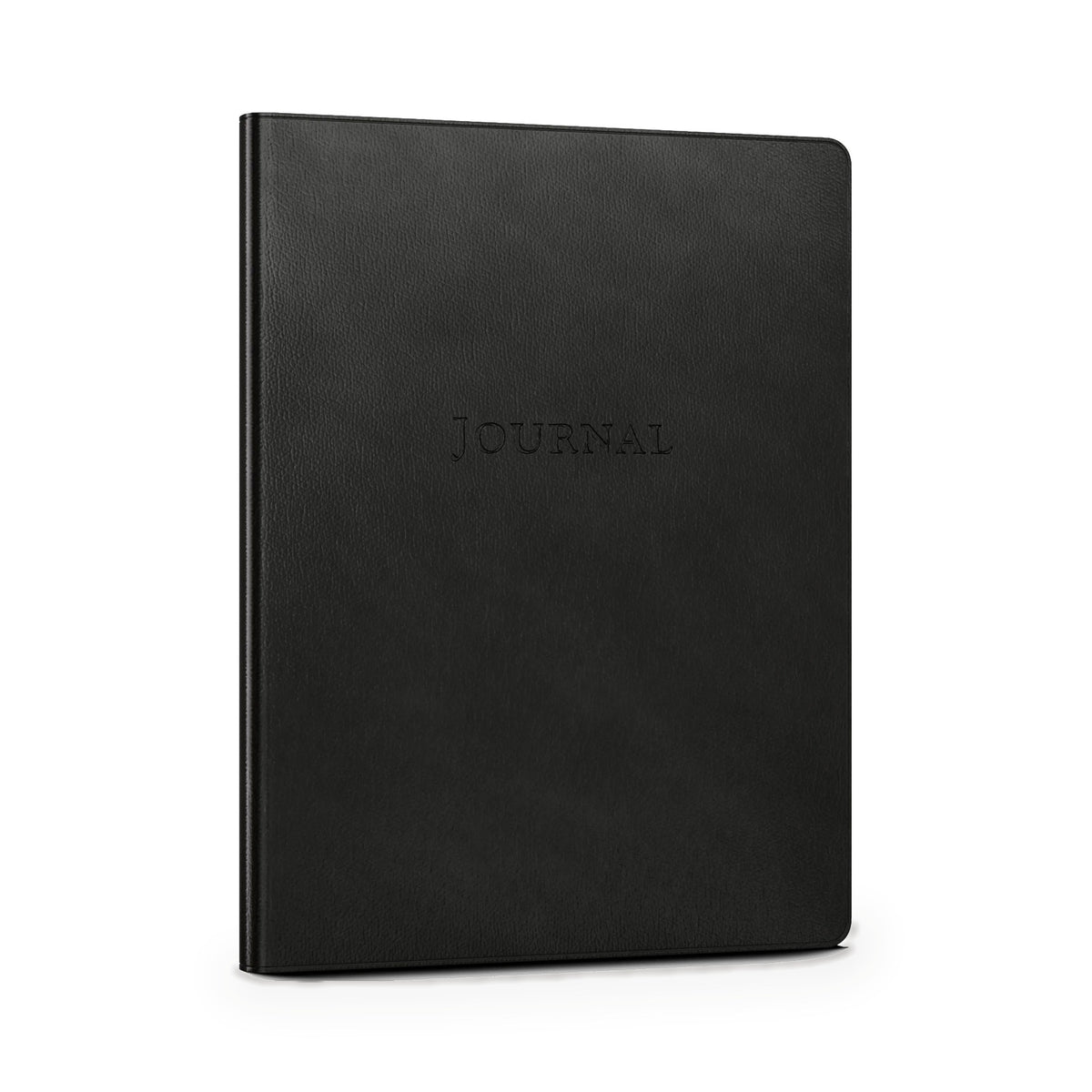
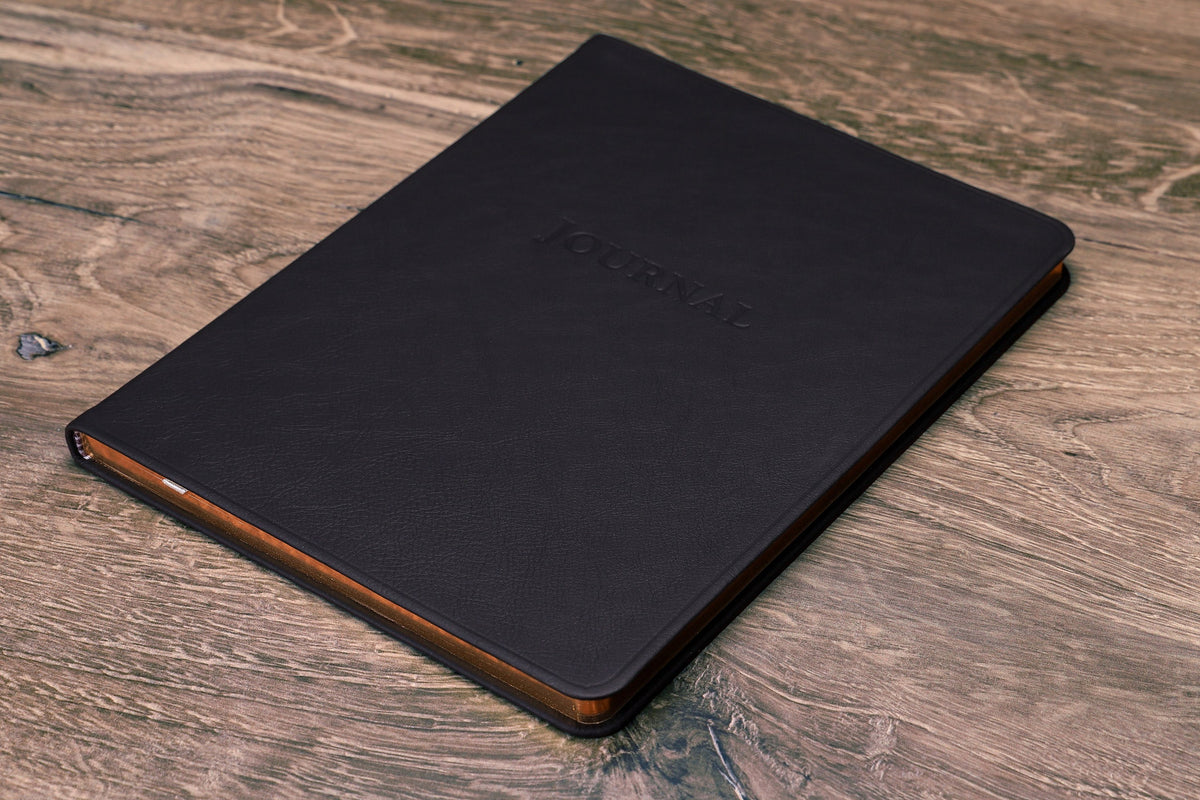
Three planners for the year ahead, two journals for the record behind. All five are full-grain leather over sewn signatures, assembled in Trenton, Maine, on a Korean book block, and guaranteed for life by the maker on construction.
The Planners
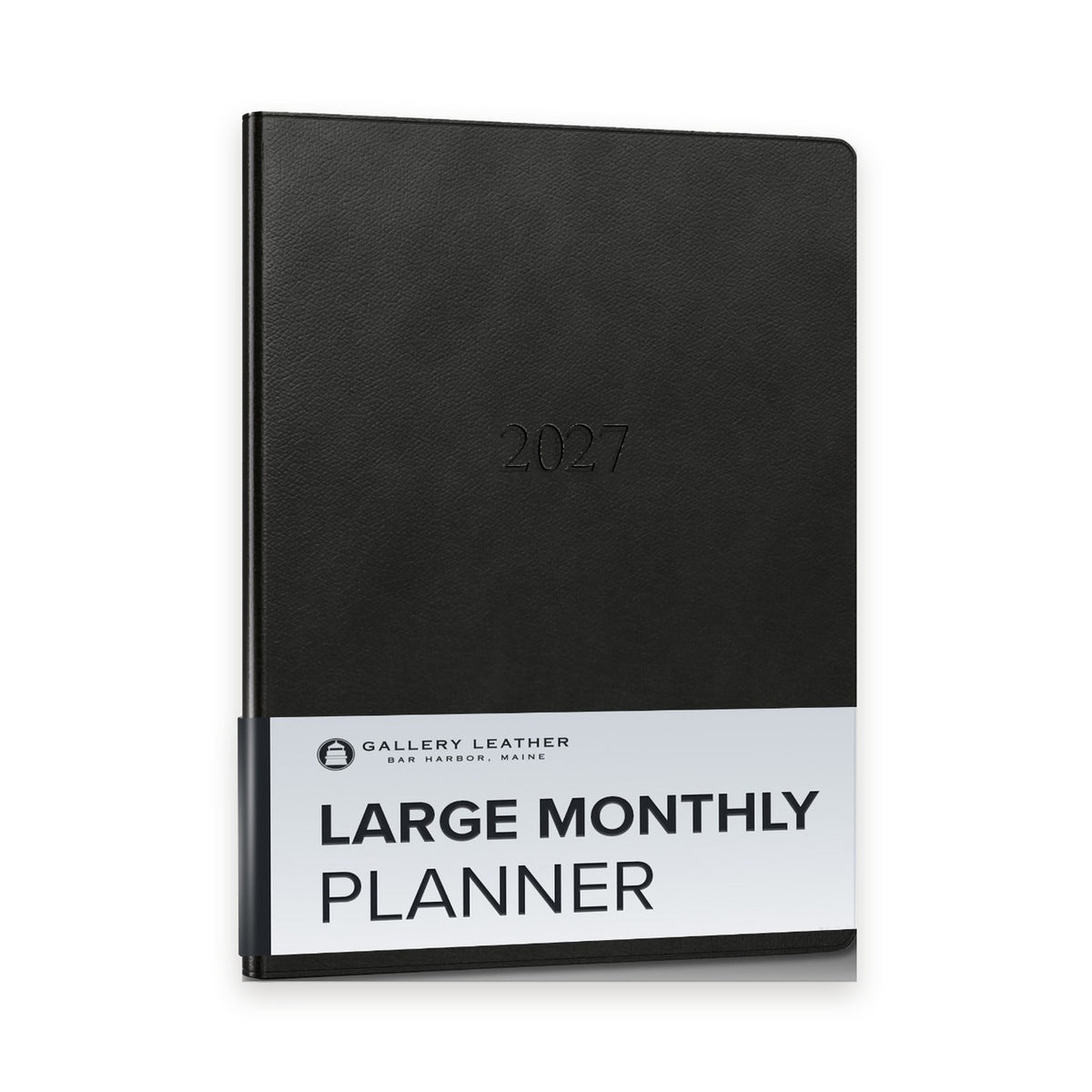
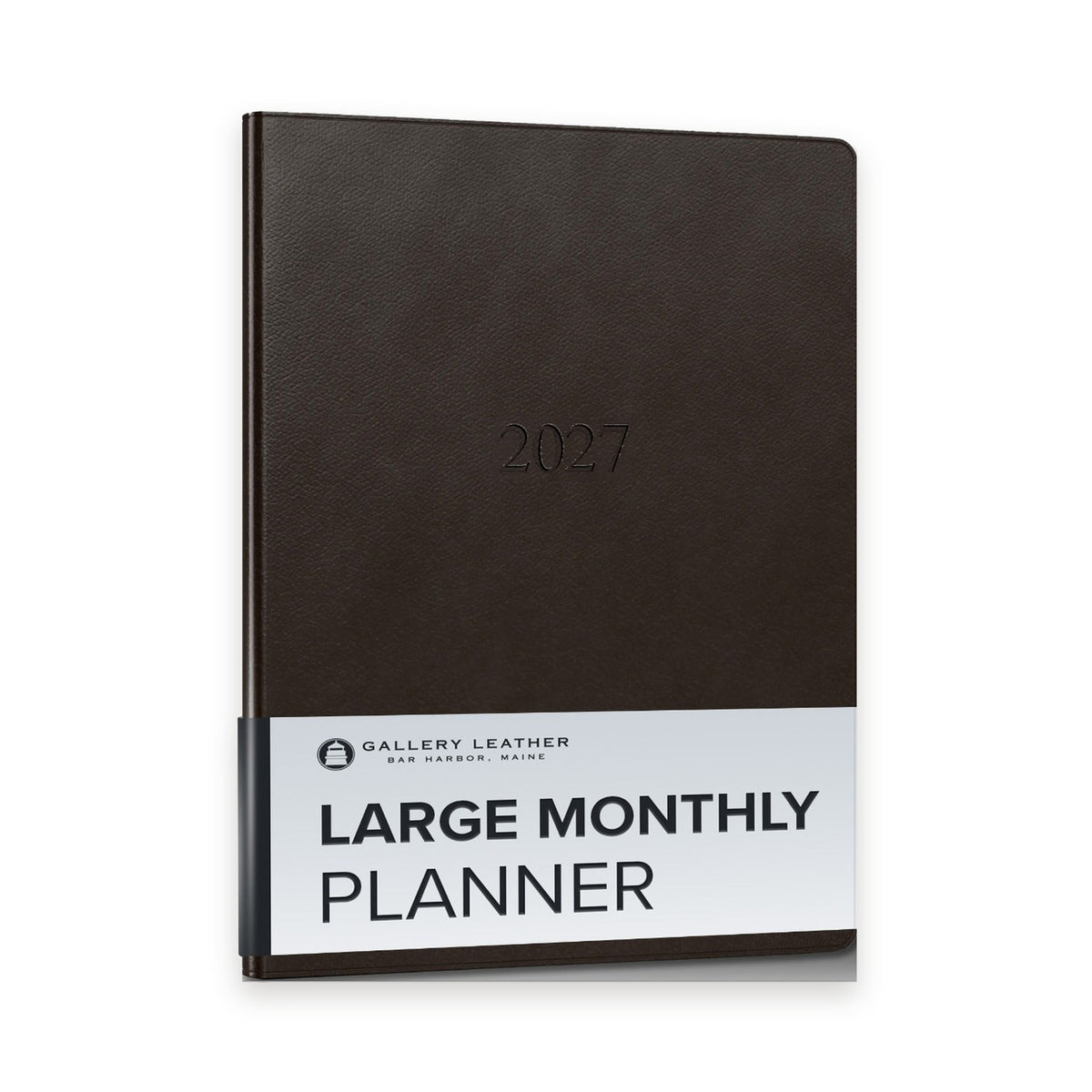
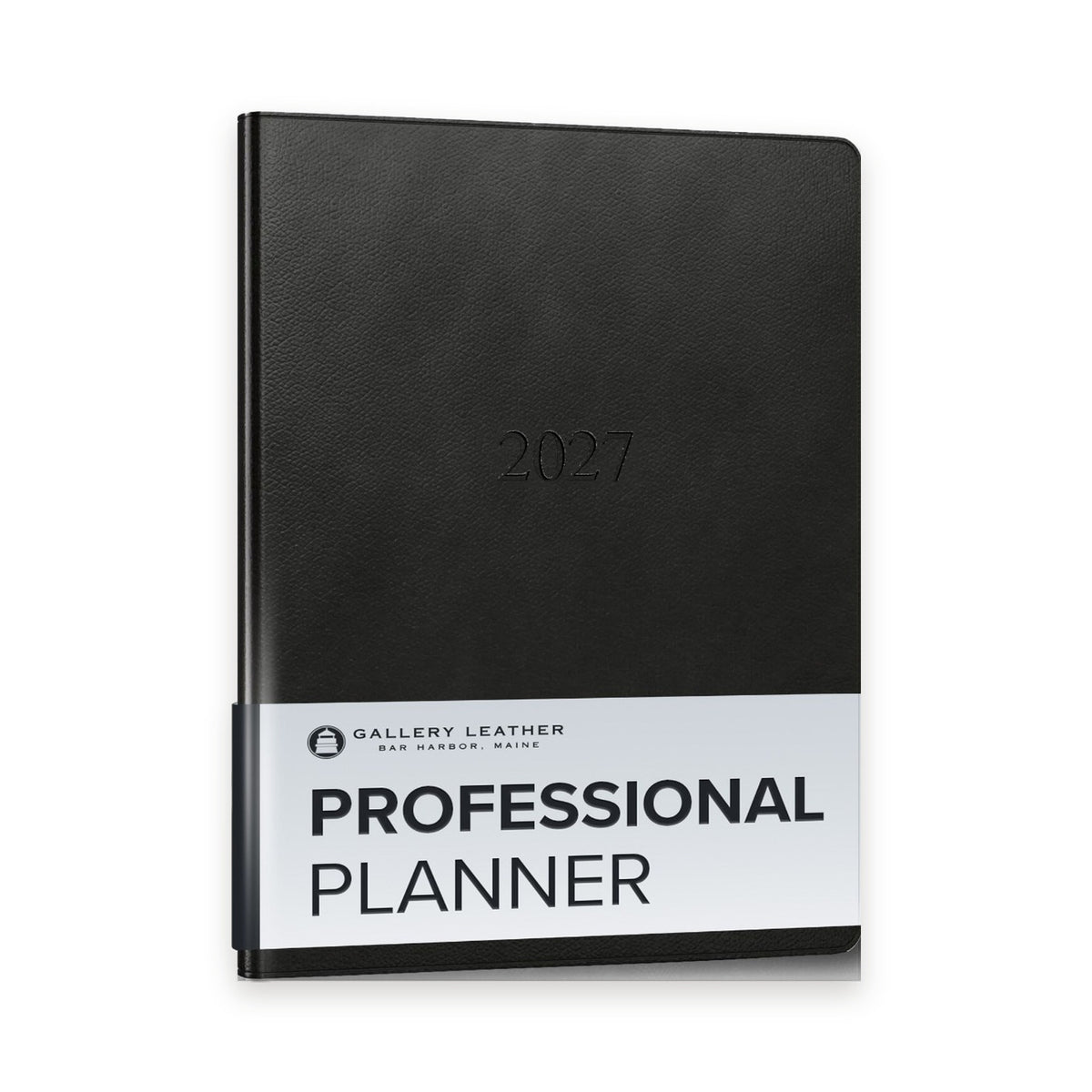
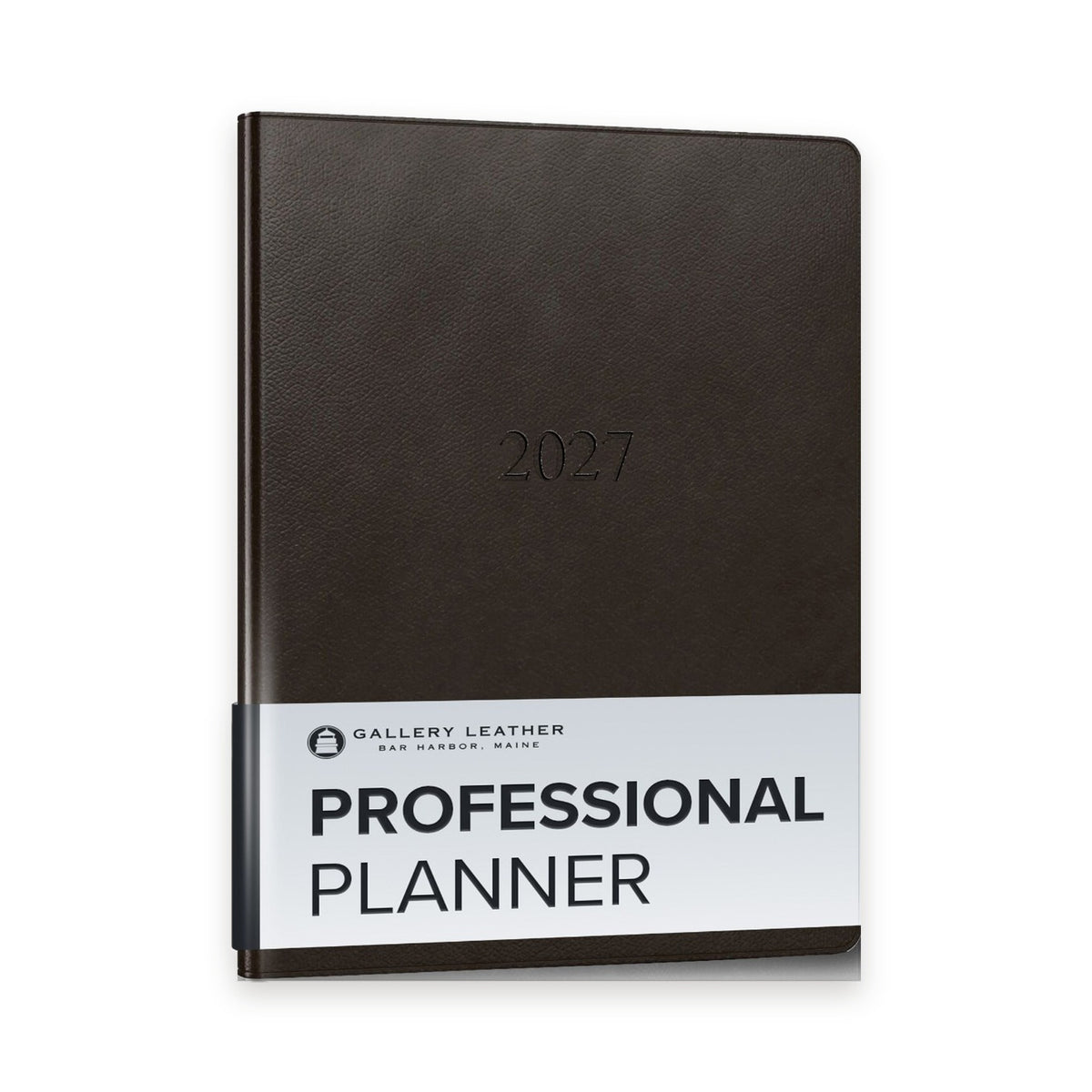
| Professional Weekly | Large Monthly | Pocket Weekly | |
|---|---|---|---|
| Layout | Two pages to the week, vertical. Monday–Friday in half-hour lines from 7 AM to 7:30 PM, every line timed, with one open line above 7 AM; Saturday and Sunday share a column of plain lines with a notes block. Monthly section behind | Two pages to the month; notes and reference pages behind | Two pages to the week; months-at-a-glance behind |
| Dated | Weeks Jan–Dec 2027; months Jul 2026–Jun 2028 | Jul 2026–Dec 2027, eighteen months | Weeks Jan–Dec 2027; months Jul 2026–Jun 2028 |
| Size | 9 × 7 in | 9.75 × 7.5 in | 6 × 3.25 in |
| Pages | 192 | 96 | 208 |
| Cover | Soft cover in six full-grain leathers — Monhegan Black, Cocoa, Saddle, Emerald; Tremont Atlantic, Garnet. Ivory ribbon marker. | ||
| Stamping | Optional, by the bindery: initials or up to two lines, gold foil, lower right. Stamped books are made to order and not returnable unless the error is the maker's. | ||
| Ships | Direct from the bindery in Trenton, in a gift box, under our name — a few business days unstamped, up to eight stamped | ||
| Price | $115 | $115 | $47 |
The monthly book opens in July of the year before, so it goes into service the day it arrives. The two weeklies begin in January and are best bought before it.
The Journals
| Large Leather Journal | Desk Leather Journal | |
|---|---|---|
| Ruling | College — approx. 7.1 mm | Narrow — 6.4 mm |
| Size | 9.75 × 7.5 in | 8 × 5.5 in |
| Pages | 192, 100 gsm, gilt edges | 192, 100 gsm, gilt edges |
| Cover | Monhegan Black full-grain | Monhegan Black full-grain, soft cover |
| Inside the cover | A printed Personal Data page — name, addresses, phone, cell, email, emergency contact. No stamping on the journals; this is the maker's answer to a book left behind, and it works only if you fill it in. | |
| Ships | From our shelf, in the maker's gift box | |
| Price | $115 | $95 |
Ruled, not blank. Almost nothing in a practice is drawn. Neither journal lies flat on the first opening; the binding wants working in, and the larger book gets there sooner.
The Docket
Which book, which job
Five situations, and the book for each. The selection is not binary — most practices need a planner and a journal, and the question is only which of each.
The day is cut in appointments
The Professional Weekly
Depositions, hearings, calls at set times. The Professional rules each weekday in half-hours from seven in the morning to half past seven at night, and a hearing that runs long shows what it pushed. The desk book for a litigator's week.
The calendar is made of dates
The Large Monthly
Signing dates, statutory deadlines, the trial set for next autumn. The Large Monthly gives each month a two-page spread and leaves the hours to the phone. It is the thinnest of the three, and the one that answers "what does the spring look like."
The date is set standing up
The Pocket Weekly
Standing in a corridor, being asked when you can come back, with the phone somewhere else. The Pocket Weekly is six inches by three and a quarter and rides in a jacket. It records that an appointment exists rather than the hours around it — a real trade, and the right one for a book that has to be on you.
The record is kept at a desk
The Large Leather Journal
The client call, the witness reached on the third try, the reasoning behind a strategy you may have to defend later — written at a table, with a margin for the second pass. The Large Journal is the book that sits open beside the file and, in ten years, on the shelf.
The record travels
The Desk Leather Journal
The note taken in a hallway, the clerk's name, the figure mentioned before anyone put it in a letter. The Desk Journal travels flat in a briefcase, and its soft cover gives rather than fights. Shorter lines and a page that fills faster, in exchange for being there when it matters.
Planner, and Journal
The forward record and the backward one
Why the honest answer to "which one" is usually "one of each."
A planner and a journal look alike on a shelf and do opposite work. The planner is written before the fact: where you will be, when, with whom. The journal is written after it: what happened when you got there, what was said, what you decided and why. One is a promise and the other is a receipt. Read together across a year they are the closest thing to a transcript of a practice that exists outside the billing system — and unlike the billing system, they are in your hand and stay in your house.
So the choice is rarely planner or journal. It is which planner, decided by how your day is cut, and which journal, decided by where you write. A litigator's desk holds the Professional and the Large Journal; a transactional lawyer's holds the Monthly and the same journal; the lawyer who is never at a desk carries the Pocket Weekly and the Desk Journal in the same bag. None of those pairings is wrong. Buying the planner without the journal is the only combination we would talk you out of, because it keeps the promise and throws away the receipt.
The Spec Sheet, Continued
The detail that fails first
The binding, and four things we would rather tell you now than have you find out.
On a book meant to be kept, the binding fails before the leather does. A glued spine drops pages as it ages, and a record with a page missing is a record with a hole in it — one the other side will find before you do. All five of these books are sewn in signatures, which is why a page cannot come out cleanly and why an entry stays where you made it. That is the construction detail the price is paying for. The gilt edges and the ribbon are pleasant; the stitching is the point.
Four honest notes. None of these books lies flat on the first opening — the binding wants working in, a few full openings with the cover bent back, and the larger books get there sooner than the smaller ones. The paper is 100 gsm on the journals, and how a fountain pen behaves on it depends on the pen and the ink as much as the sheet, so we make no promise beyond this: a broad marker or watercolor will bleed straight through. The planners are dated, which is what makes them a record and what makes them perishable; the monthly book is useful from the July before the year, and the two weeklies from January. And every cover is a hide, not a print, so yours will not match the photograph exactly.
Closing Argument
Keep the screen for what it does: the alarm, the shared calendar, the search. Keep the book for what the screen cannot: the whole month in one look, a second calendar that owes nothing to the first, and a record that leaves the firm with you and can be handed across a table when someone asks what happened. Court reporters keep their notes for ten years by law and the Library of Congress keeps a justice's for good; you are allowed a shelf. The Professional, the Monthly and the Pocket Weekly are the forward record; the Large and Desk journals are the backward one. Choose based on what you will need to look at again, not on what you need to be reminded of today, and you'll rarely choose wrong.
Shop Journals & PlannersMORE FROM THE FIELD GUIDE
The Churchill, or the Silk?
The Catalog Case: Hand Carry or Wheeled?
The Shirley, or the Camilla?
Padfolio, or Portfolio?
Card Case, or Card Wallet?
Fine Nib, or Medium?
Fountain, Rollerball, or Ballpoint?
A Cigar, Counselor?
Season It, or Ruin It?

Written by James Kaywell