Card Case, or Card Wallet?

Field Guide No. 02
Card Case, or
Card Wallet?
The object you hand to someone, versus the one you keep to yourself.
A business card is a small, old-fashioned piece of paper that still closes more deals than a LinkedIn request. What holds that card — and what holds the rest of your cards — are two different objects doing two different jobs.
Most stores shelve them side by side and treat them as interchangeable. They are not.
The Distinction, Plainly Stated
| Business Card Case | Card Wallet | |
|---|---|---|
| Primary job | Holds the cards you intend to give away | Holds the cards you intend to keep |
| How it is used | Opened in front of someone | Pulled from a pocket, used, and put away |
| Typical capacity | 10–25 business cards | 8 cards + divided currency |
| Lives in | Jacket interior pocket | Jacket pocket, bag, or briefcase |
| What it signals | "Here's my card." | "That's private." |
A business card case is built to be opened in front of someone — often with a simple lift-flap that presents one card cleanly. A card wallet is built to disappear into a pocket and handle daily cards, cash, and identification without ceremony.
What follows is which one belongs in which pocket, and when you actually need both.


Exhibit A — The Business Card Case
Built to be opened in front of someone.
A business card case holds exactly the cards you intend to give away. It's meant to be opened in front of someone, not rummaged through — a simple lift-flap puts one card into your fingers before the other person has finished saying hello.
- ALift-flap opening — the case opens along the top edge, presenting the top card in one motion.
- BInterior capacity — 10 to 25 cards, depending on the build.
- CStitched edge — hand-stitched seams outlast glued ones by years, not months.
| Typical size | ≈ 3.9" × 2.4", closed |
|---|---|
| Capacity | 10–25 business cards |
| Best for | Introductions, networking, first meetings |
As Illustrated
Closed
In Use
The Counsel, in black or warm brown full-grain leather.
Exhibit B — The Card Wallet
Built to disappear into a pocket.
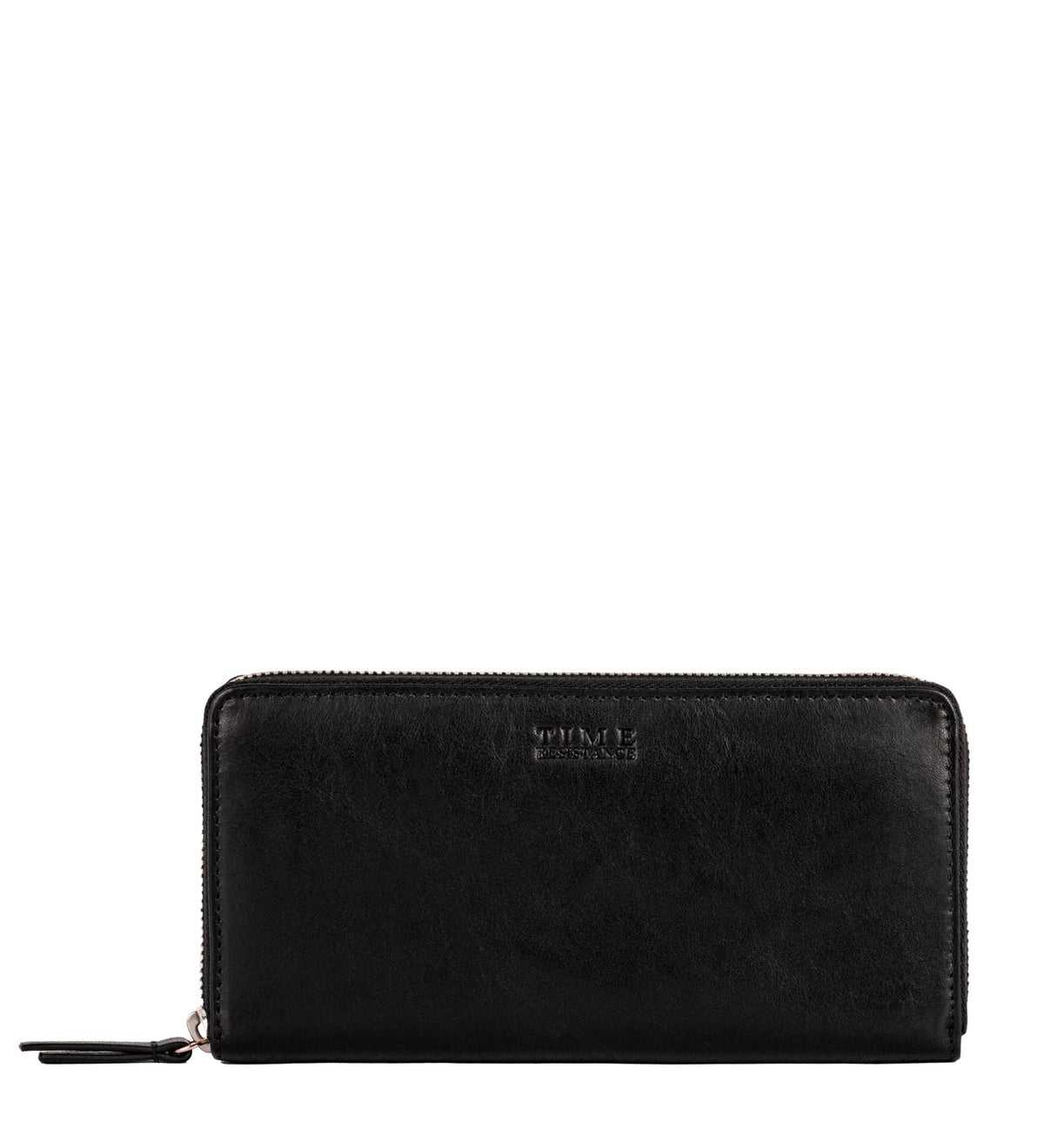
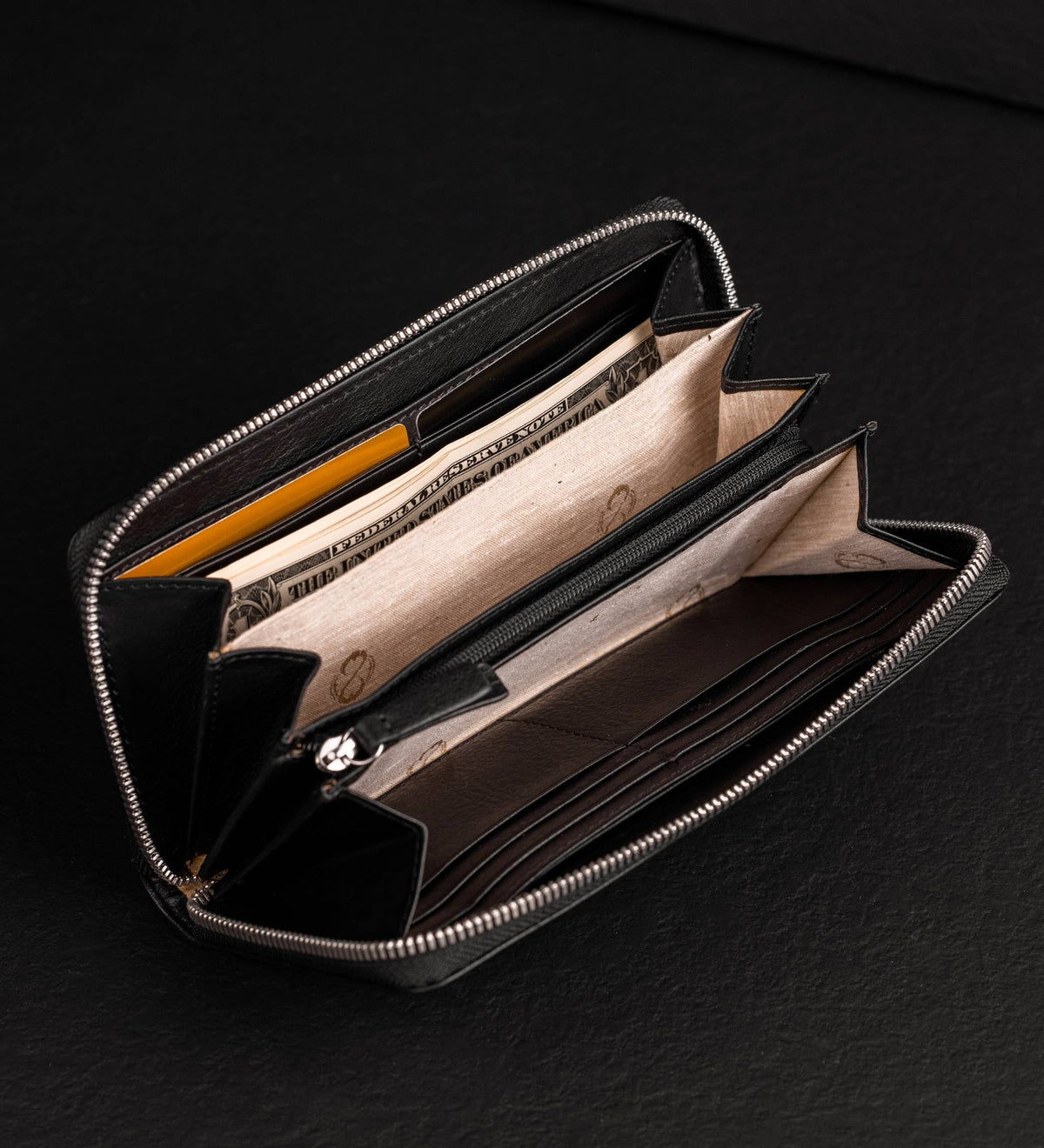
A card wallet holds the cards that are yours to keep — credit cards, a driver's license, the hotel key you'll forget to return. It lives in a pocket all day and is built to be pulled out, used, and put away without ceremony, which is a very different job from being handed across a table.
- ACard slots ×8 — graduated depth, so you find the right one by feel.
- BDivided currency pocket, plus two receipt pockets — not every court in the country takes a card for parking.
- CRFID-blocking lining — a low-cost reassurance layer. Contactless cards generate a one-time code for each tap and transmit little personal data, so real-world skimming is rare,1 but it's worth having and worth not thinking about again.
- DID window — the one card you actually want visible without pulling the wallet out.
- EStitched edge — same reasoning as Exhibit A. Glue is not a construction method.
| Typical size | ≈ 4.5" × 3.5" × 0.5", closed (bifold) |
|---|---|
| Capacity | 8 cards, plus divided currency and two receipt pockets |
| Best for | Daily carry, travel, anywhere you're not networking |
- Bree Fowler, The Many Ways to Make Contactless Payments, Consumer Reports (Aug. 30, 2020) (Salt Security co-founder and CEO Roey Eliyahu: skimming requires "near-perfect conditions at close range"; "there have been no documented cases of RFID-based credit card fraud"); see also Sarah Elizabeth Adler, Do You Really Need an RFID-Blocking Wallet?, AARP (updated May 8, 2026) (quoting Visa: "Fraud from skimming is very unlikely and limited in scope"). ↩
As Illustrated
Closed
Open
The Retainer, in black or warm brown full-grain leather.
The Docket
Which one, which pocket
Four moments, and the case for each.
Introduction / networking
Business Card Case
The card should be moving toward their hand before you finish saying your name.
Daily carry / commute
Card Wallet
You don't hand this one to anyone. It works forty times a day without being noticed.
Court appearance
Neither — pocket only
The one room where nobody wants your card, and a thick wallet prints through a suit jacket.
Travel / conference
Both
The wallet does the daily work. The case comes out for the introductions on the way home.
Exhibit C — Anatomy of an Edge
The detail that fails first
Painted edge — the raw edge is sanded, sealed, and burnished smooth, then finished with a coat of edge paint. Clean and economical, though the coating can crack or peel at the corners after a few years of pocket friction.
Edge-stitched — the leather is folded or backed and joined with a visible line of stitching, usually saddle-stitched by hand. Slower to make, but the seam is structural rather than cosmetic, which is why it tends to outlast the case around it.2
- Tanner Bates, Maker Techniques: Leather Edges, tannerbates.co.uk/blogs/news/maker-techniques-edges (noting painted edges are not durable — "if you've ever owned a leather wallet... over time the edge peels off" — as against an exposed, hand-burnished edge, which the same maker calls the most durable finish). ↩
Closing Argument
A card case is the one professional accessory built to be watched while it's being used — someone is looking at your hands the moment you open it. That's a strange amount of pressure to put on a small rectangle of leather, but it's exactly why the good ones earn their price. Choose based on who's watching, and you'll rarely choose wrong.
Shop Card Cases & WalletsMORE FROM THE FIELD GUIDE
Padfolio, or Portfolio?
Fine Nib, or Medium?
A Cigar, Counselor?
The Churchill, or the Silk?
The Catalog Case: Hand Carry or Wheeled?
Season It, or Ruin It?
The Shirley, or the Camilla?
Fountain, Rollerball, or Ballpoint?

Written by James Kaywell