The Shirley, or the Camilla?

Field Guide No. 08
The Shirley, or
the Camilla?
The bag that carries the working day, versus the one that carries everything else.
These are the first two pieces in our women's line, both made by Time Resistance of full-grain, vegetable-tanned Italian cowhide — Vachetta, the leather that darkens and improves with use. They are curated pieces, which means they carry their maker's identity rather than ours, including their names. Both are named for novels, and both novels are worth the footnotes below.
They look related because they are. They are not, however, interchangeable — one is built for the working day and one is built for every other day, and buying the wrong one means owning a bag that is always slightly the wrong size. The distinction is capacity and intent, and it is worth getting right the first time.
The Distinction, Plainly Stated
| Shirley | Camilla | |
|---|---|---|
| Primary job | Carries the working day — a letter size file, a tablet, the things that go to court | Carries the essentials — and declines to carry more |
| Format | Structured work tote, the larger of the two | Structured shoulder bag, rated by the maker at 4.5 liters |
| Dimensions | 15" base · 13.5" opening · 10" high · 5" deep | 4.5 liters, per the maker |
| Closure | Magnetic; the front buckle is decorative | Magnetic, extra-strong |
| Lining | Jacquard | Cotton |
| Colorway | Black | Cognac brown matte |
| What it signals | "I brought the file." | "The file is at the office." |
What follows is which bag belongs to which day — and why the honest answer, for most practices, is eventually both.


Exhibit A — Shirley, the Work Tote
Built to stand at counsel table.
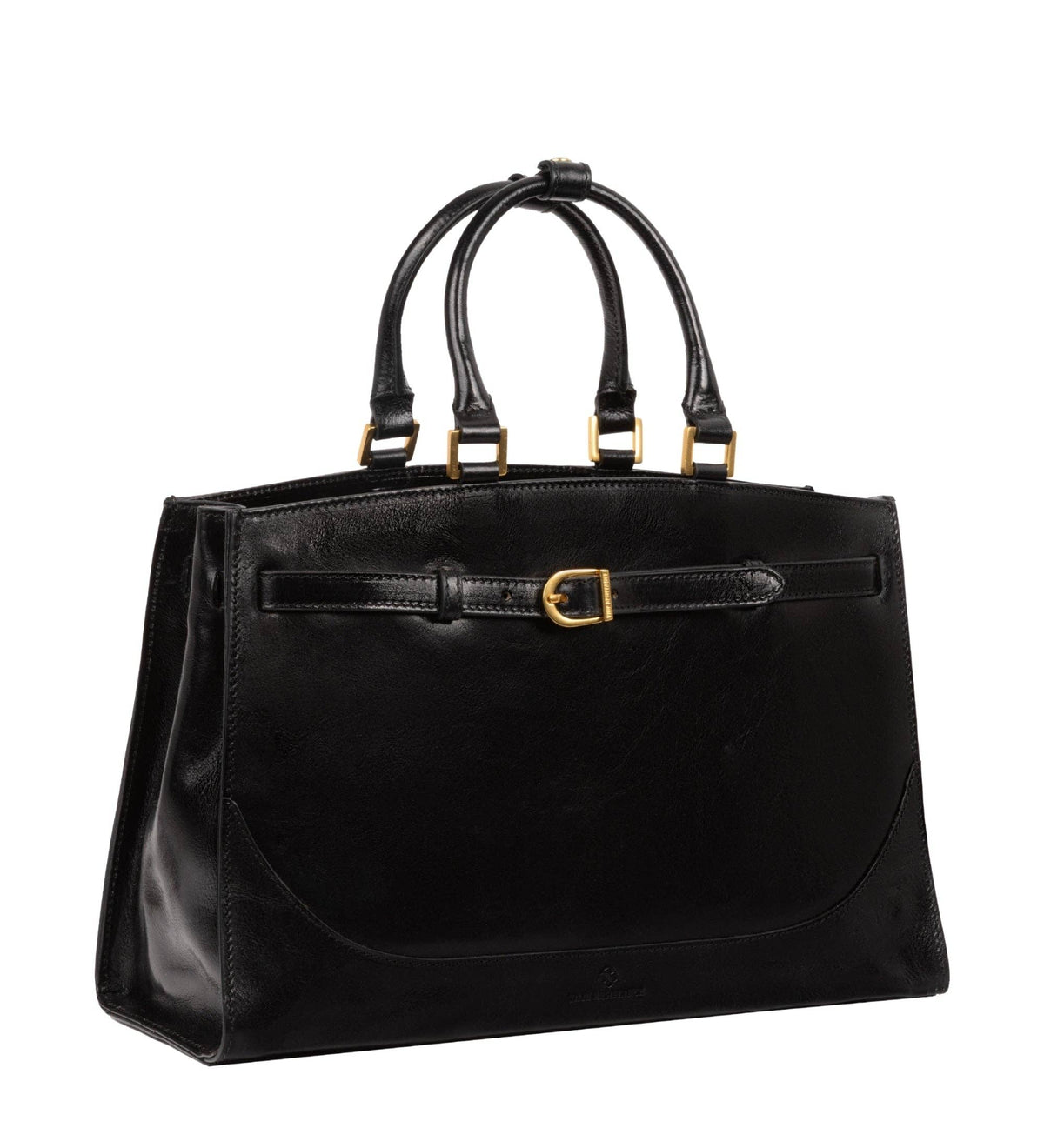
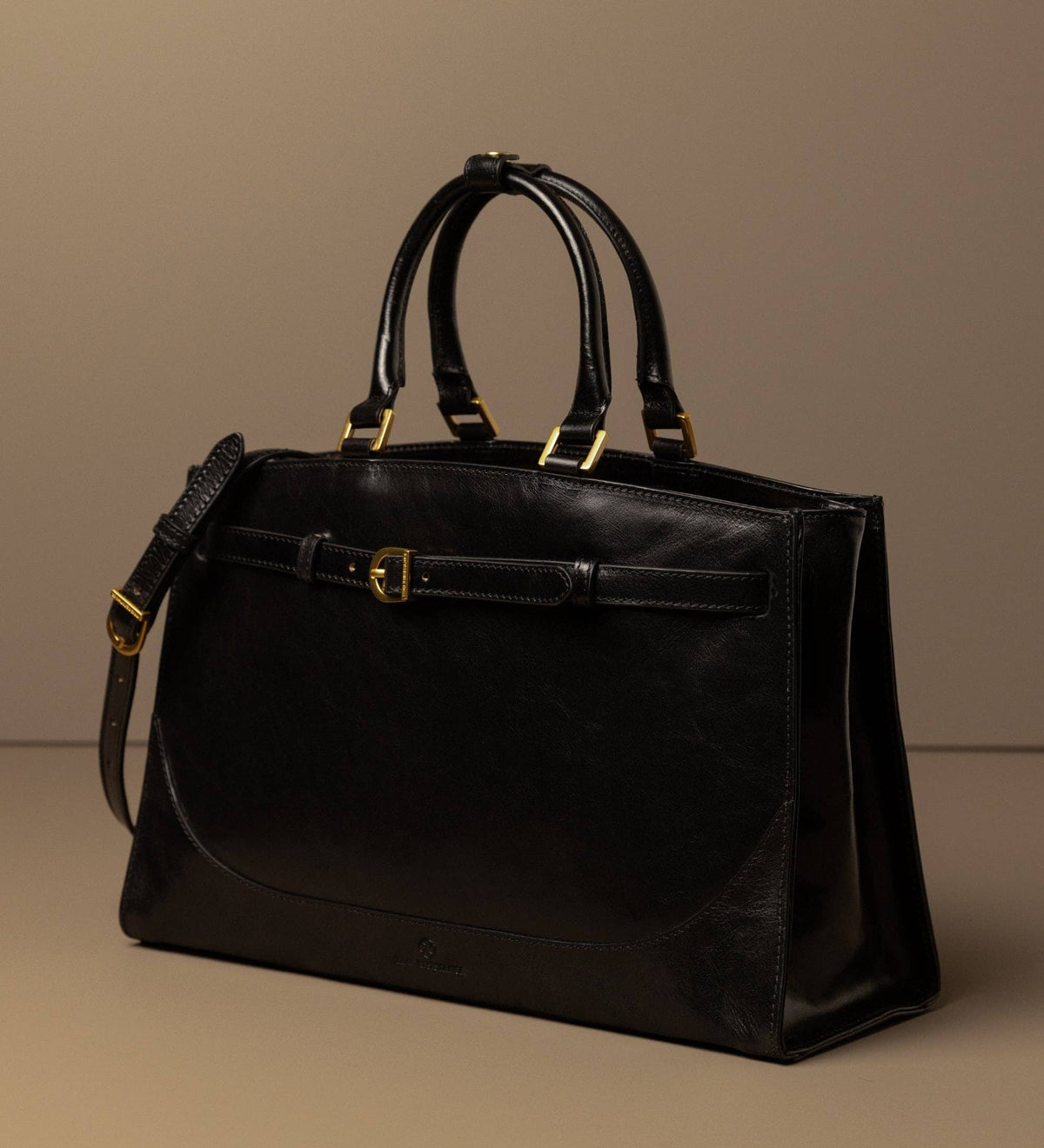
Shirley is the work bag: two full compartments separated by a central zip pocket, sized to carry documents and the working day between office and courtroom. The structure is not a styling decision. A bag that holds its shape stands upright when you set it down and opens flat when you reach into it — you find things instead of excavating them. On the question that matters to a practice: a letter-size folder goes in and the bag closes over it. A legal-size one does not — at fourteen inches it is longer than the bag will take in any direction, and no amount of angling solves it.
- AFront strap and buckle — decorative. The actual closures are magnetic and open with one hand while the other holds everything else.
- BCentral zip pocket dividing the two main compartments — the phone, the keys, the things that otherwise sink.
- CProtective metal studs on the base. Courthouse floors are not kind, and this bag was built by someone who knew it.
- DAdjustable, detachable shoulder strap — hand-carry into the conference room, shoulder-carry through the parking garage.
| Leather | Full-grain, vegetable-tanned Italian cowhide (Vachetta), hand-dyed |
|---|---|
| Dimensions | 15" across the base, 13.5" across the opening, 10" high, 5" deep — 15" overall with the handles up |
| Takes | A letter-size file, completely inside. Not a legal-size one. |
| Best for | The working day: hearings, depositions, the office, the letter-size file |
In Practice

Fifteen inches across the base, carried over the forearm — the handle drop clears a suit sleeve.
As Illustrated
Shirley — Black
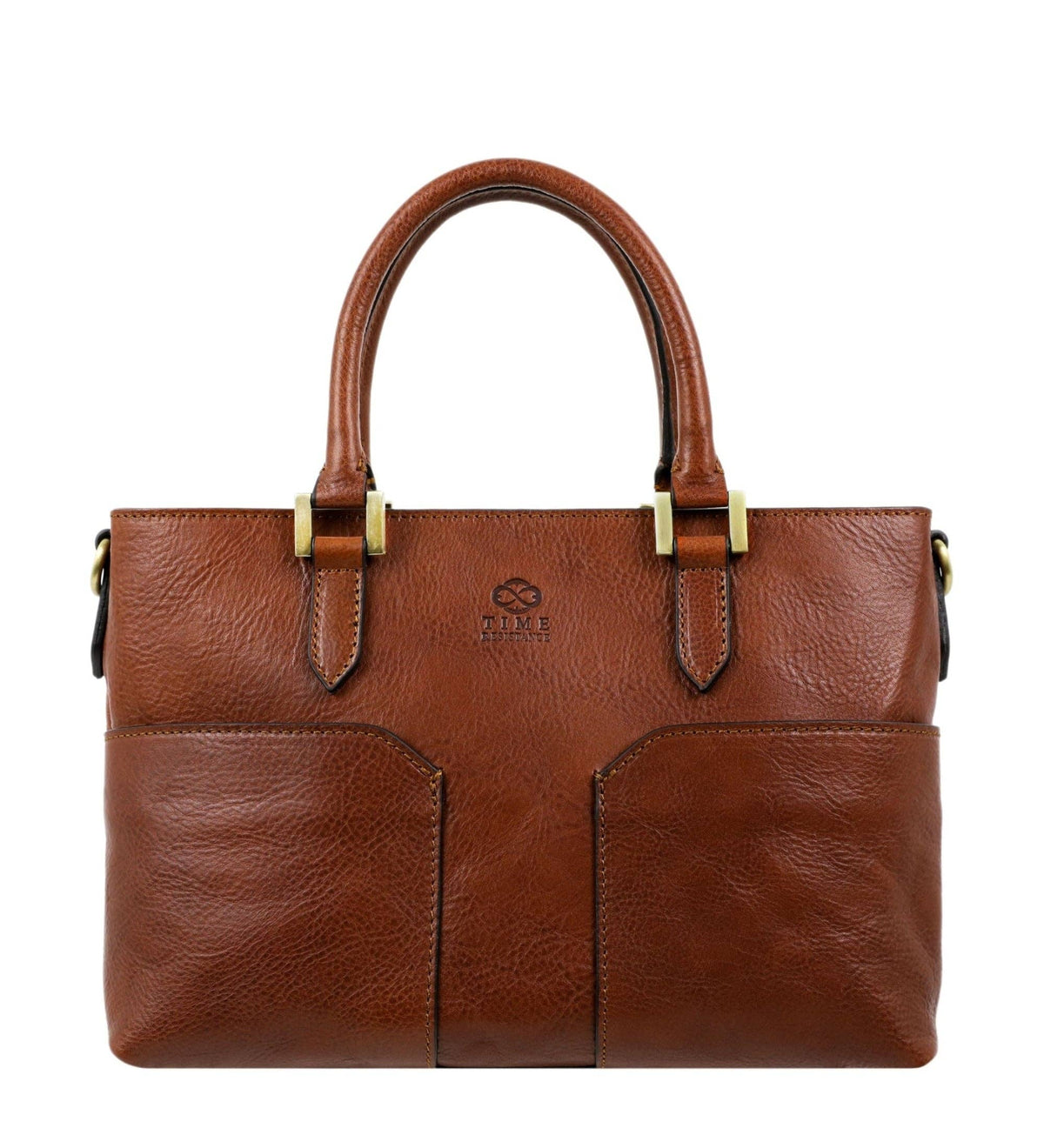
Camilla — Cognac Brown Matte
Both in full-grain Vachetta, by Time Resistance. Illustrations are schematic; the photographs on the product pages are the evidence.
Exhibit B — Camilla, the Shoulder Bag
Built to decline the extra file.
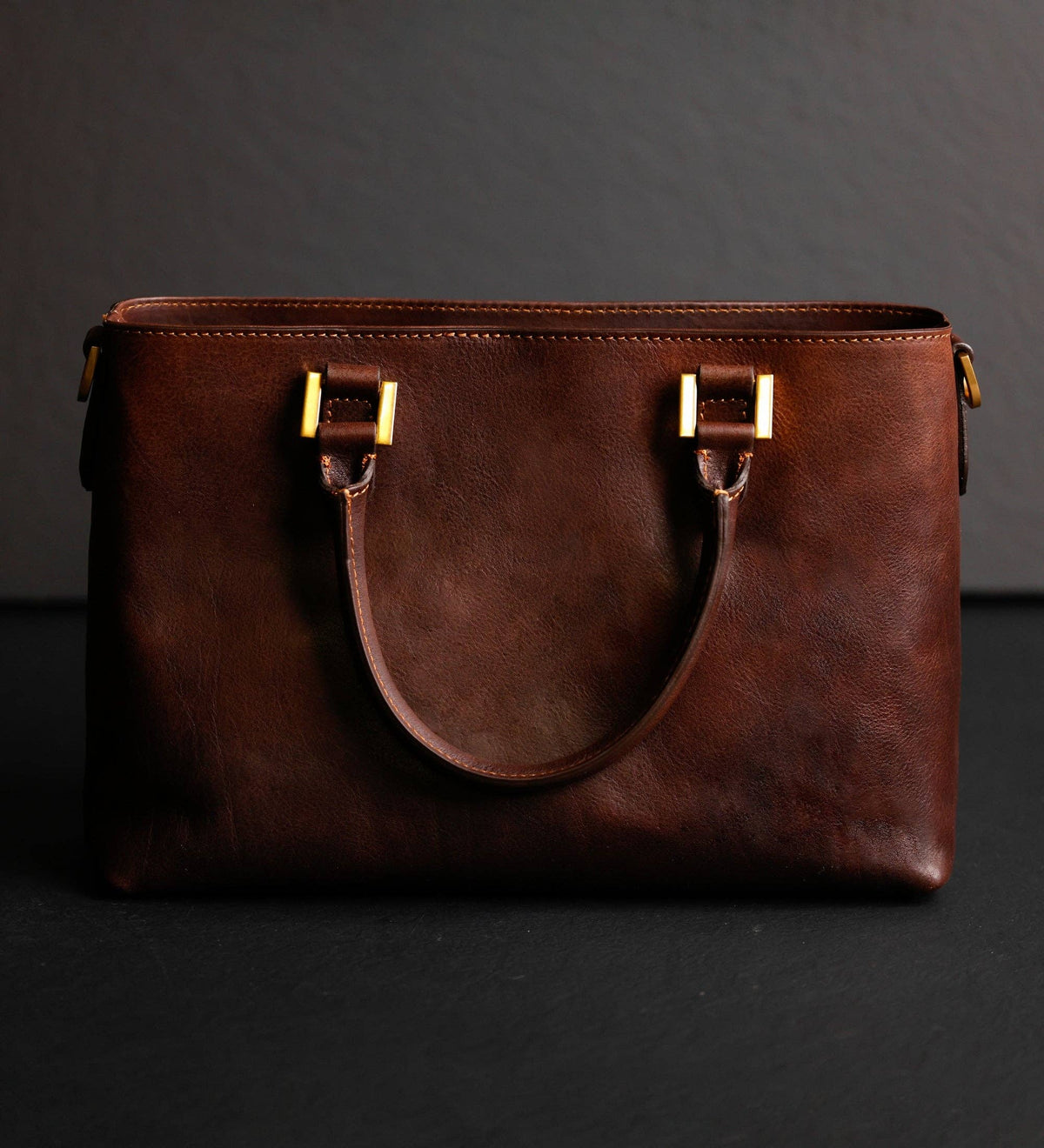
Camilla holds the essentials and, usefully, nothing else. The maker rates it at 4.5 liters — about a gallon and a quarter — across two compartments and a divider with its own zip pocket. That is a real day's carry: wallet, keys, phone, glasses, the paperback. It is not a briefcase, and its refusal to become one is the feature.
- ATwo slip pockets on the front — for the things that come out at a counter: the transit card, the sunglasses, the receipt.
- BCenter divider with a zip pocket of its own — the secure middle layer between the two open compartments.
- CExtra-strong magnetic closure. It shuts with a click you can hear, which is the entire point of a magnetic closure.
- DDetachable strap, adjustable in length — shoulder, or hand-carry by the twin handles.
| Leather | Full-grain, vegetable-tanned Italian cowhide (Vachetta), hand-dyed |
|---|---|
| Capacity | 4.5 liters (1.19 gallons), per the maker |
| Best for | Every day the tote stays home: the lunch, the errand, the weekend |
In Practice

Four and a half litres, carried over the forearm — the essentials, and a firm refusal to take the file.
The Docket
Which one, which day
Four moments, and the case for each.
Motion calendar
Shirley
The motions folder rides inside the bag, not under your arm — letter-size, case law printed out, the whole errand. A tote that stands upright at counsel table is a tote that isn't thought about again until the recess.
Client lunch
Camilla
Big enough for the essentials; small enough to say the workday is being held elsewhere. It sits on the chair beside you, not the floor.
CLE weekend
Shirley
A conference is a working day with worse chairs. The materials, the handouts, the charger — the bigger bag earns its shoulder strap.
Saturday, mostly
Camilla
Errands, and the one call you take anyway. The phone lives in the divider pocket. Everything else can wait until Monday, where Shirley is.
A Note on Paper Size
Letter, yes. Legal, no.
Shirley stands ten inches tall and five deep, which gives a longest interior run of a shade over eleven inches. Letter paper is eleven. A letter-size folder therefore goes in and the bag closes over it — we checked with a file in hand rather than a tape measure. A motions folder with the case law printed out is exactly the errand this bag runs.
Legal-size is fourteen inches, and no angle inside this bag will take it. If your jurisdiction still runs to legal-size pleadings, that is the thing to know before you buy rather than after. For the day that adds a laptop to the folder, the bag is The Woman in White.
Exhibit C — The Names on the Spine
Two novels, properly cited
Shirley is Charlotte Brontë's second published novel. Its heroine, Shirley Keeldar, bears the name her parents had reserved for a son — Brontë writes that, granted only a daughter, they "bestowed on her the same masculine family cognomen they would have bestowed on a boy."1 The book was popular enough to turn Shirley into a woman's name, which it has been ever since. A work bag could be named worse things.
Camilla is Frances Burney's third novel, published by subscription — the Georgian version of raising the printing costs up front, with the subscribers' names printed at the front of the book. The 36-page list included one "Miss J. Austen, Steventon": the first time Jane Austen's name appeared in print, and one of only two occasions in her lifetime that she permitted it.2 She was twenty, and a subscriber before she was an author.
- Charlotte Brontë, Shirley, ch. 11 (1849) (Shirley Keeldar's parents, "who had wished to have a son, finding that Providence had granted them only a daughter, bestowed on her the same masculine family cognomen they would have bestowed on a boy"). ↩
- The Burney Centre, McGill University, Frances (Fanny) Burney d'Arblay (1752–1840), mcgill.ca/burneycentre (the 36-page subscription list to Camilla "reads like a who's who of late 18th-century English society," including "a Miss J. Austen, Steventon"); see also The Cambridge Companion to Frances Burney ch. 7 (Cambridge Univ. Press) (the first of only two occasions on which Austen sanctioned the appearance of her name in print). ↩
Closing Argument
A work tote is not a briefcase that apologizes, and a shoulder bag is not a tote that gave up — they are different instruments for different days, and the only mistake is asking one to be the other. Choose based on what the day asks you to carry, not what the room expects to see, and you'll rarely choose wrong.
Shop Women's Leather GoodsMORE FROM THE FIELD GUIDE
Padfolio, or Portfolio?
Card Case, or Card Wallet?
Fine Nib, or Medium?
A Cigar, Counselor?
The Churchill, or the Silk?
The Catalog Case: Hand Carry or Wheeled?
Season It, or Ruin It?
Fountain, Rollerball, or Ballpoint?

Written by James Kaywell