The Catalog Case: Hand Carry or Wheeled?

Field Guide No. 06 · Chain of Custody
The Catalog Case:
Hand Carry, or Wheeled?
When the matter outgrows a briefcase, the only decision left is whether you carry it or roll it.
A catalog case exists for one reason: the files, binders, exhibits, and laptop no longer fit in a standard briefcase. Once that happens, the case gets larger and heavier — and someone has to decide whether that weight rides on an arm or on wheels.
Korchmar offers two answers. We carry both as-is.
The Two Options
| The Workhorse | The Litigator | |
|---|---|---|
| Carry method | Hand carry only | Wheeled, or hand carry with the handle retracted |
| Best suited for | Daily office circuit, one building, one floor | Courthouse runs, airport travel, trial week with stacked banker's boxes |
| Defining feature | Three-dial combination lock on a rigid steel frame | Telescoping handle that also braces stacked boxes |
| What it says | "The file stays with me." | "The file needed its own vehicle." |
Our hand-carried case, the Workhorse, is built for the short, repeated trip: parking lot to lobby to desk and back. Our wheeled case, the Litigator, is built for longer routes — through security, up elevator banks, or across a terminal — and for the practical second job many litigators already use it for: stacking banker's boxes on top and using the extended handle as a support brace.
What follows is the practical case for choosing between them, including the confidentiality and work-product reasons the lock and construction actually matter.


The Argument
Chain of Custody
Three grounds for why the case matters as much as what's riding inside it.
Ground I — The Lock Is a Confidentiality Control
The duty travels with the file.
ABA Model Rule 1.6(c) requires a lawyer to "make reasonable efforts to prevent the inadvertent or unauthorized disclosure of, or unauthorized access to, information relating to the representation of a client" — and its Comment 18, which speaks of acting "competently to safeguard" that information, is written in technology-neutral terms rather than being confined to servers and email.1 A three-dial combination means nobody borrows a key at a hotel front desk, nobody duplicates one at a courthouse cloakroom, and nobody opens it but you. That isn't a convenience feature. It's the cheapest, lowest-tech way to satisfy an obligation you already have.
Ground II — What's Inside Is Legally Shielded
Hickman v. Taylor put a wall around it.
The notes, strategy memos, and mental impressions a lawyer carries to and from court aren't just private — they're work product, a protection the Supreme Court created in Hickman v. Taylor (1947) and was later codified in Federal Rule of Civil Procedure 26(b)(3).2 Add the attorney-client privilege covering the client communications riding alongside it, and what's physically inside that case is exactly the category of material the law goes out of its way to keep sealed. The lock on the outside is the last, most literal link in a chain that starts with a Supreme Court opinion.
Ground III — The Handle Has a Second Job
It's a support brace, on paper.
Litigators have long stacked banker's boxes of exhibits, pleadings, and trial notebooks directly on top of a wheeled case and run the extended handle up behind the stack to hold it together — and the practice is established enough to have been patented. U.S. Patent 5,988,334, Wheeled Briefcase — filed by a Florida appellate lawyer, not by Korchmar — describes it plainly: "When the rods are extended, the handle construction acts as a support brace, preventing unsecured movement of items placed on top of the closed container."3 It isn't an improvised hack. It's a use case the design already accounted for.
- American Bar Association, Model Rules of Professional Conduct, Rule 1.6(c) & cmt. 18, americanbar.org/groups/professional_responsibility/publications/model_rules_of_professional_conduct/rule_1_6_confidentiality_of_information/comment_on_rule_1_6 (duty to "act competently to safeguard information relating to the representation of a client against unauthorized access by third parties," assessed by sensitivity of the information and likelihood of disclosure absent safeguards). ↩
- Hickman v. Taylor, 329 U.S. 495 (1947), supreme.justia.com/cases/federal/us/329/495 (establishing the work-product doctrine protecting an attorney's trial-preparation materials from discovery absent a showing of necessity); subsequently codified at Fed. R. Civ. P. 26(b)(3) (1970). ↩
- U.S. Patent No. 5,988,334, Wheeled Briefcase (Edna Caruso, filed Feb. 5, 1998, issued Nov. 23, 1999), patents.justia.com/patent/5988334 (describing a court-briefcase design in which the telescoping handle, when extended, "acts as a support brace, preventing unsecured movement of items placed on top of the closed container"). The patent is unrelated to Korchmar and has since expired; it is cited here as an early description of the practice, not as the design's provenance. ↩
- Korchmar company history, korchmar.com/pages/our-story (company founded in Cincinnati in 1917; now in its fourth generation; wholly owned factories in Florida and the Dominican Republic). The 1917 date is the company's, not this product's: the first Korchmar goods were automobile lamp visors, thermos cases, and leather corners for steamer trunks, with cases for professionals following later. ↩
- Gear Patrol, "The Unsung Hero of the Leather Bag World," gearpatrol.com/style/a290593/korchmar-leather-luggage (2021) (reporting that the company's wheeled catalogue cases are favorites of airline pilots and lawyers). See also National Jurist, "Lawyers and briefcases go hand-in-hand," nationaljurist.com (2026) (identifying Korchmar's wheeled catalog case among the bags lawyers weigh for court use, and quoting a purchaser recommending it for that purpose). ↩
Exhibit A — The Workhorse
The one for the trip you make five times a day.
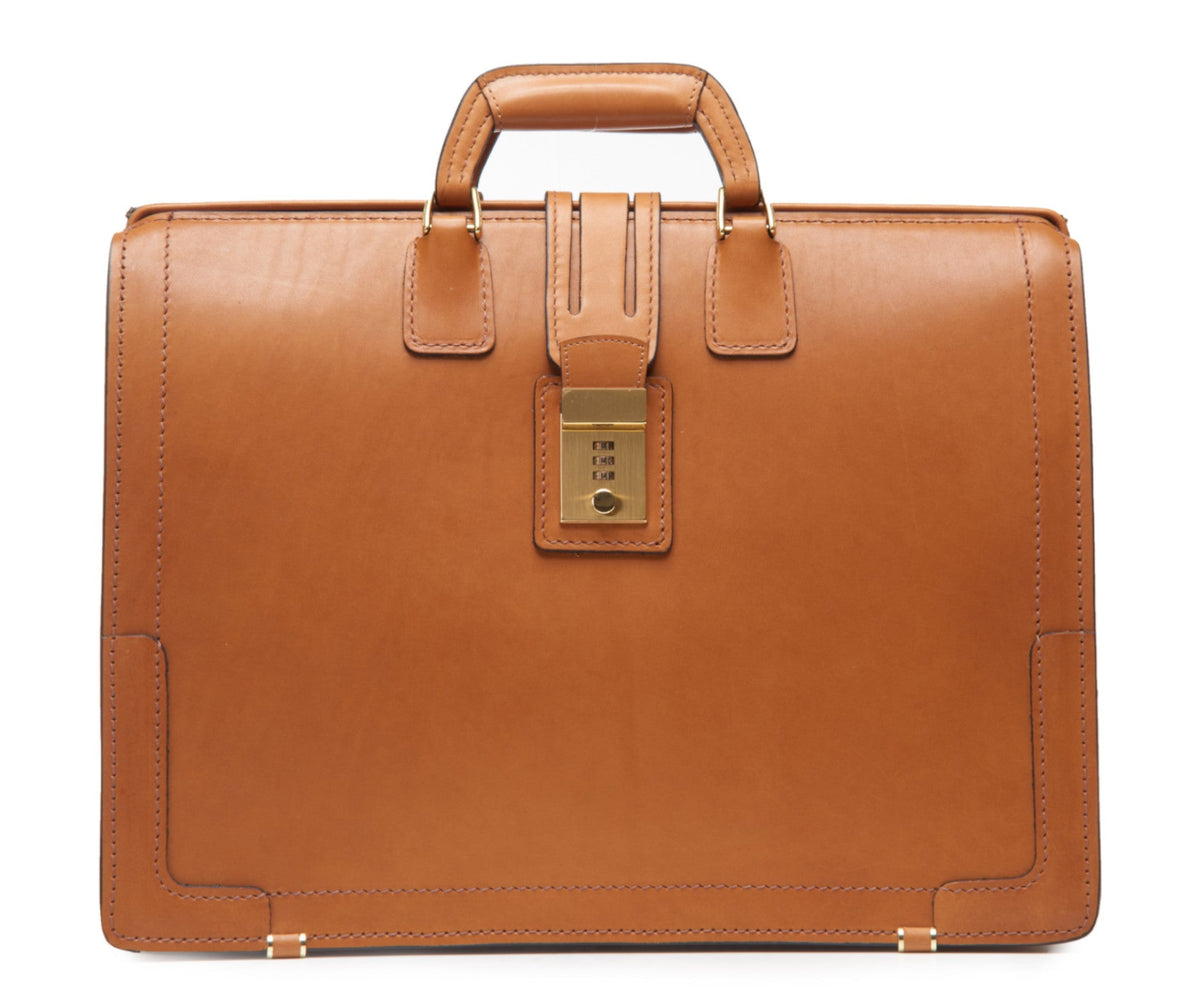
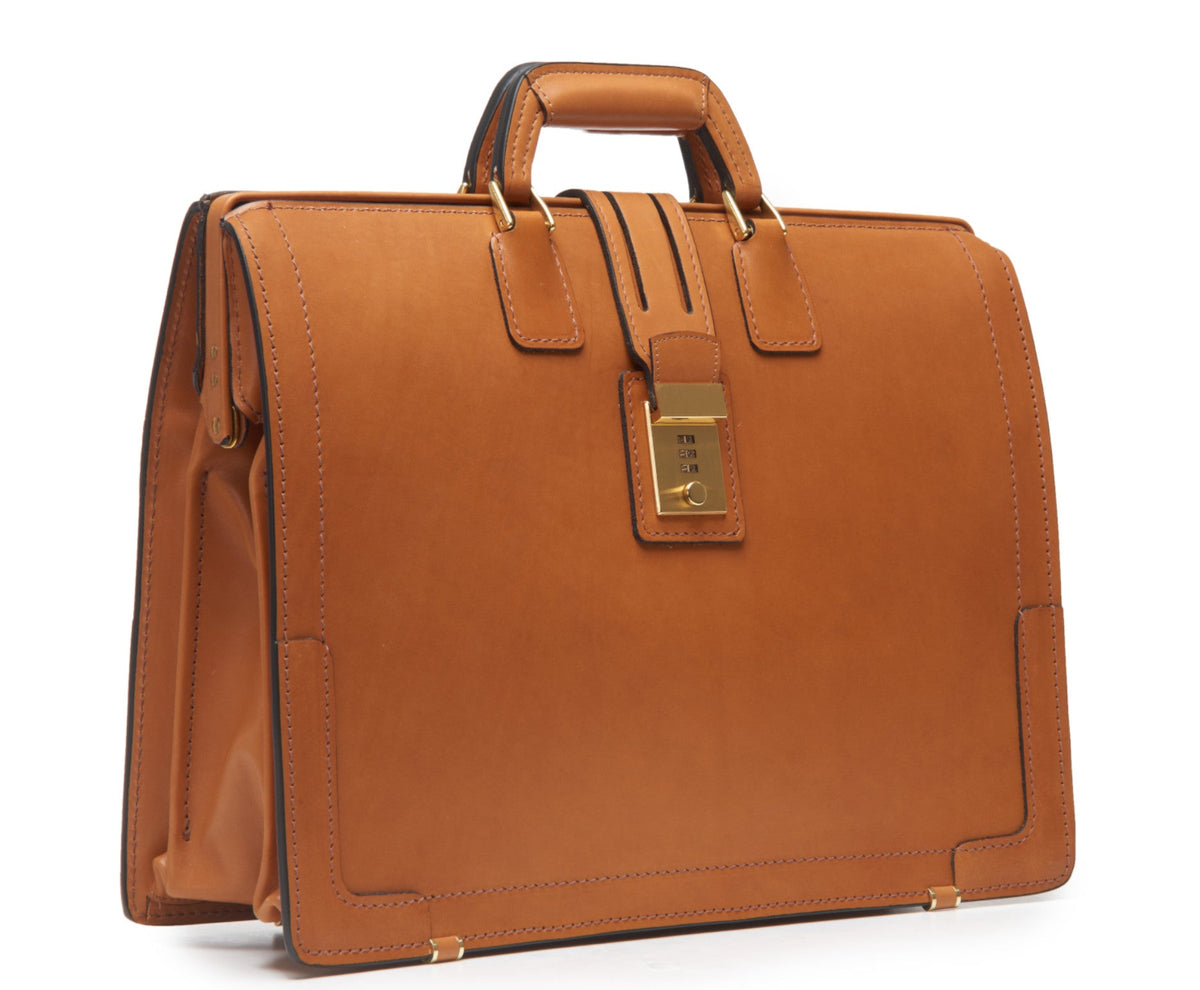
The Workhorse is Korchmar's standard catalog case — top-grain American leather over a riveted, heavy-gauge steel frame, closed with a three-dial combination lock instead of a key. It's sized for the daily circuit that never involves an airport: trunk to lobby, lobby to desk, down the hall to a client meeting, and back to the car at the end of the day, garage to house. A load that's substantial — files, a laptop, a trial notebook — but never overbearing on one arm, and never open to anyone who doesn't know the combination.
- AWrap-around protective corners — survive the trunk, the elevator door, and the office chair leg equally well.
- BThree-dial combination lock — a confidentiality safeguard under ABA Model Rule 1.6(c), not just a way to avoid losing a key.
- CRiveted heavy-gauge steel frame under top-grain American leather — holds its shape at the load a daily commute actually demands.
- DBusiness organizer panel beneath the lid, plus two full-length expanding partitions and a 17" laptop compartment.
| Made by | Korchmar — American leather, finished in the Dominican Republic |
|---|---|
| Dimensions | 20" × 9" × 14" |
| Carry method | Hand carry only — no wheel option |
| Typical route | Parking lot → office → down the hall → back to the car → home |
| Best for | One building, one floor, a load you can still carry yourself |
Exhibit B — The Litigator
The one that carries either way.
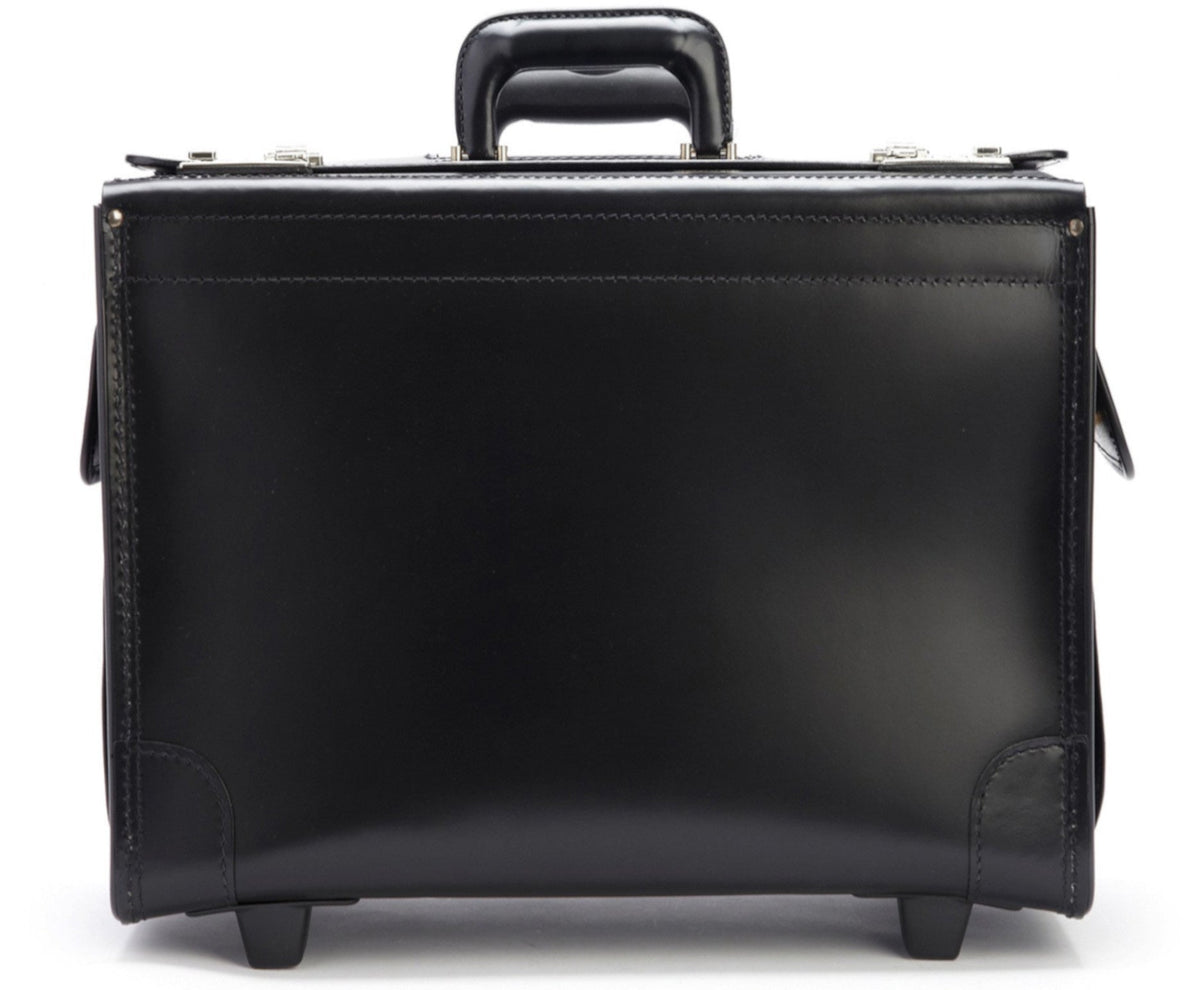
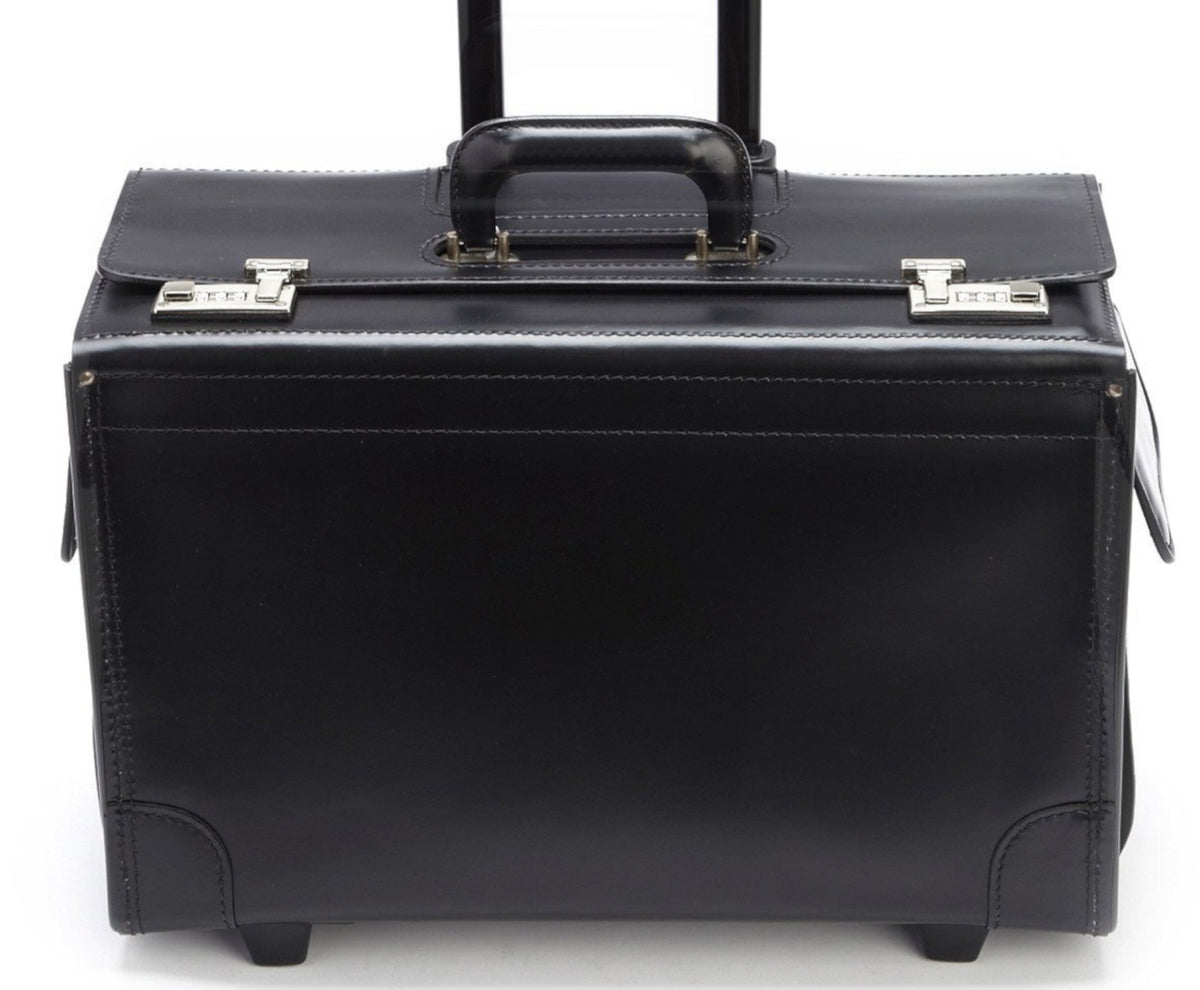
The Litigator is the same catalog case built for the version of the daily circuit that runs longer: parking lot to courthouse entrance, through security, up the elevator bank to the courtroom — or car to curb to gate, for the deposition or hearing that isn't in town. Same top-grain American leather over a riveted steel frame, same organizer panel and expanding partitions, plus a telescoping handle and wheel set for the distance an arm shouldn't have to cover twice a day. It runs taller than the Workhorse — built for the height of a standing file, not just a laptop.
The wheels are an addition, not a requirement: retract the handle and it hand-carries exactly like the Workhorse, for the tight elevator, the crowded aisle, or the day it's simply not worth extending four stages of handle for forty feet. The Litigator isn't a wheeled case that happens to have a handle — it's a hand-carry case that also rolls.
It also does a second job many litigators already rely on without thinking of it as a feature: stack the banker's boxes of exhibits, pleadings, and trial notebooks straight on top, extend the handle up behind the stack, and the case becomes the hand truck nobody issued you. The hardware is built to take that load — see Ground III.
- ALightweight, exterior-mounted telescoping handle — also acts as a support brace for banker's boxes stacked on top.
- BWheel set on the same riveted steel frame — turns "parking lot to the ninth floor" into the case's job, not your arm's.
- CExtruded T-Rail protective bumper edge, plus a steel-core padded leather carry handle for the stairs and curbs the wheels can't take.
- DBusiness organizer beneath the lid, two full-length expanding partitions, and a 17" laptop compartment.
| Made by | Korchmar — American leather, finished in the Dominican Republic |
|---|---|
| Dimensions | 18" × 9.5" × 16" |
| Carry method | Wheeled, or hand carry with the handle retracted |
| Typical route | Parking lot → courthouse security → elevator → counsel table (or car → curb → gate) |
| Best for | Trial week, banker's boxes of exhibits, no extra hands |
The Spec Sheet
Side by side
One catalog case, two carry methods — not a hierarchy, a choice.
| The Workhorse | The Litigator | |
|---|---|---|
| Format | Catalog case | Wheeled catalog case |
| Carry method | Hand carry only | Wheeled, or hand carry with handle retracted |
| Typical route | Parking lot, office, down the hall, home | Parking lot to courthouse to counsel table, or curb to gate |
| Getting it there | Steel-core carry handle | Telescoping handle + wheel set, plus a carry handle for stairs |
| Security | Three-dial combination locks, one per latch | Three-dial combination locks, one per latch |
| Height | 13" or 14" — sized to a laptop | 16" — sized to a standing file |
| Second job | None needed — the load stays in one hand | Base for stacked banker's boxes, handle as support brace |
| Without saying it, it says | "The file stays with me." | "The file needed its own vehicle." |
The Docket
Which one, which day
Four moments, and the case for each catalog case.
Parking lot to the office, down the hall to a client meeting
The Workhorse
A load that's substantial but not overbearing, carried in one hand, all day. The combination lock keeps privileged material closed between meetings — no key to hand off, none to leave behind.
Parking lot to courthouse security, elevator to the courtroom
The Litigator
A longer walk, through a security line, up a bank of elevators. Wheels take on the labor an arm would resent by the second stop.
Car to the curb, curb to the gate
The Litigator
The same case that rolled out of the garage rolls straight through security and onto the jet bridge, for the deposition or hearing that isn't local.
Trial week: exhibits, pleadings, trial notebooks, no extra hands
The Litigator
Stack the boxes on the lid and the extended handle braces the load — a use a 1999 wheeled-briefcase patent describes in almost exactly those terms.
Statement of Interest
Why we don't make one.
We sell both of these cases. We made neither, and we don't intend to.
The house collection exists where we thought we could do a thing well and put our name on it. There is no house catalog case. Korchmar has been in business since 1917, is run by the fourth generation of the founding family, and builds in factories it owns;4 its wheeled catalog cases are already favored by airline pilots and lawyers.5
We could commission a catalog case. It would be worse, and cost more to cover the tooling. That isn't a standard — it's a line extension.
Two Korchmar cases, presented as Korchmar made them.
— James Kaywell
Closing Argument
A catalog case's real job was never to look the part. It's chain of custody, twice a day, for material a Supreme Court opinion and your own bar rules say has to stay sealed until you decide otherwise. The Workhorse makes that trip on an arm. The Litigator makes it on wheels when the distance calls for it, and on an arm when it doesn't — a case built to carry more than itself, a use a patent examiner had occasion to describe in 1999, before most litigators got around to naming the trick. Pick the carry method that matches the actual route, not the one that looks better standing still.
Shop BriefcasesMORE FROM THE FIELD GUIDE
Padfolio, or Portfolio?
Card Case, or Card Wallet?
Fine Nib, or Medium?
A Cigar, Counselor?
The Churchill, or the Silk?
Season It, or Ruin It?
The Shirley, or the Camilla?
Fountain, Rollerball, or Ballpoint?

Written by James Kaywell