Padfolio, or Portfolio?

Field Guide No. 01
Padfolio, or
Portfolio?
The smallest decision you'll make before a deposition — and the one your client actually notices.
Every lawyer eventually stops carrying loose paper. The only remaining question is what replaces it.
"Padfolio" and "portfolio" are used interchangeably in most stores and online listings. They should not be. The two are built for different moments, and bringing the wrong one into the wrong room is the kind of small mistake a client notices without being able to name why.
The Distinction, Plainly Stated
| Padfolio | Portfolio | |
|---|---|---|
| Closure | Snap or magnetic tab | Zip, usually three-sided |
| Capacity | One pad, a few cards, one pen | Full pad, loose documents, often a tablet |
| Typical size (closed) | ≈ 9.5" × 12.5" | ≈ 10.5" × 14" |
| Best suited for | Court, quick check-ins, one free hand | Depositions, intake, carrying what you leave with |
| What it signals | "I only need what's already decided." | "I'm prepared for what isn't decided yet." |
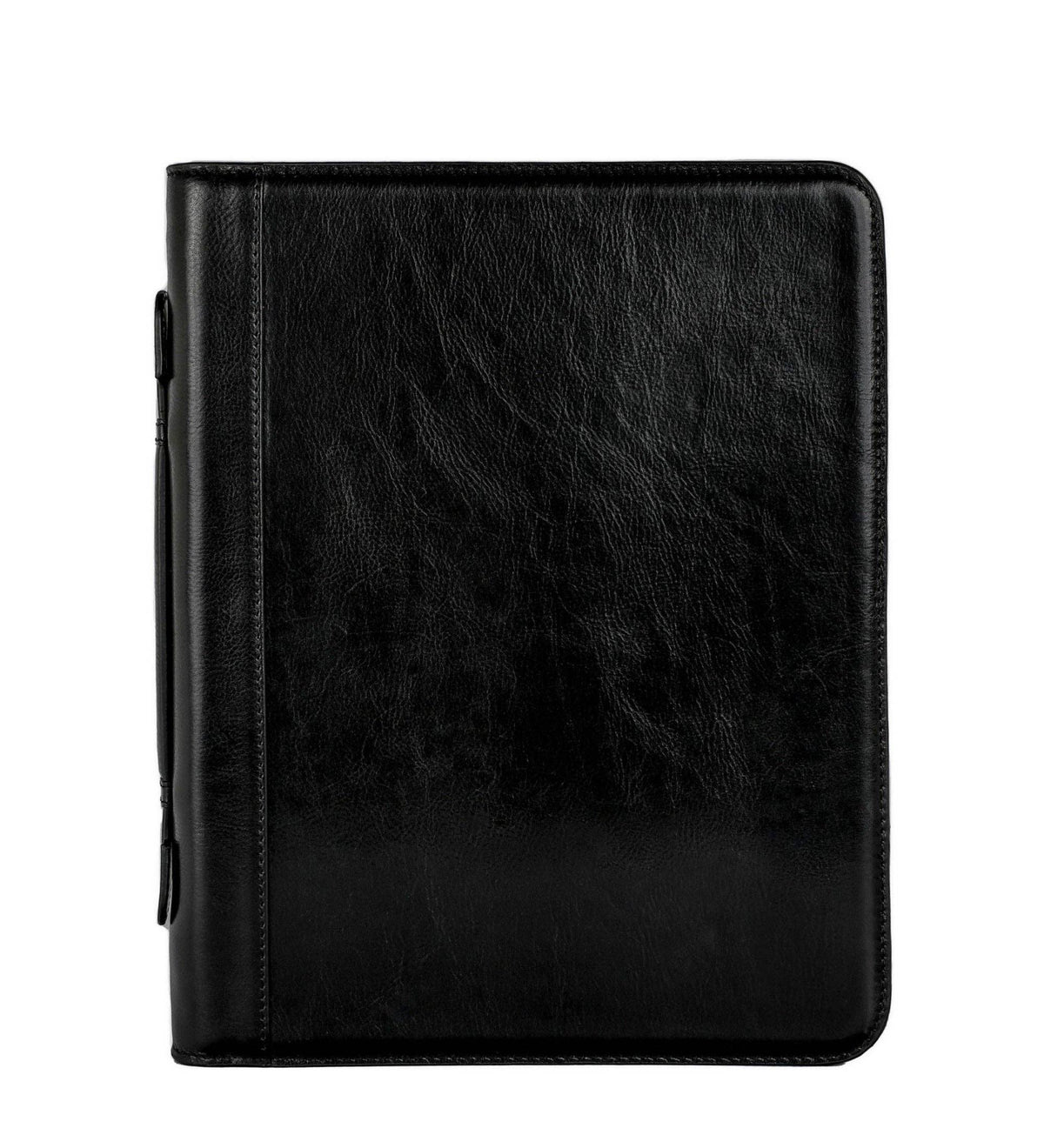
A padfolio is the slim, single-motion case: open, take notes, close. A portfolio is the larger, zippered case built to hold the signed original, the extra exhibit, or the file someone hands you mid-meeting.
What follows is which one belongs in your hand at court, at intake, at a deposition, and everywhere in between.


Exhibit A — The Padfolio
Slim. Single motion. Done.
A padfolio is the smaller, single-fold case: a notepad, a few cards, one pen, closed with a snap rather than a zip. It exists to do one thing quickly — open, take notes, close — which is exactly what you want walking up to counsel table, into a quick client check-in, or through a metal detector that doesn't love zippers.
- ANotepad, letter size — held by an interior clip, not loose.
- BCard slots ×3 — business cards, a license, a hotel key.
- CPen loop — one pen. Exactly one. That's the point.
- DSnap closure — one motion, nothing to unzip at counsel table.
| Typical size | ≈ 9.5" × 12.5", closed |
|---|---|
| Capacity | One pad, a few cards, one pen |
| Best for | Court, quick check-ins, one free hand |
Exhibit B — The Portfolio
Room for what you didn't arrive with.
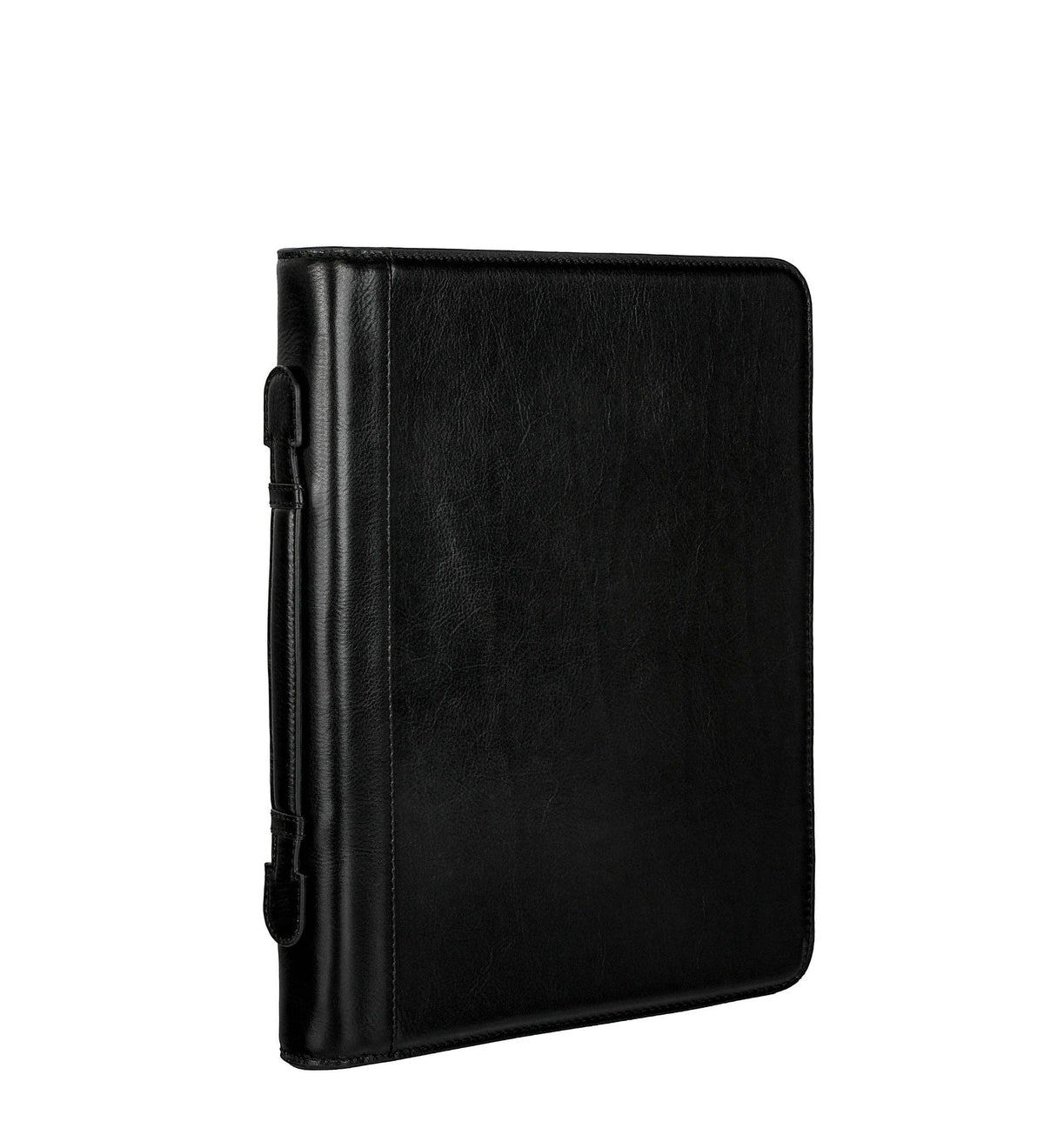
A portfolio is the larger, usually zippered case, built to carry things you didn't walk in holding — a signed original, a second file someone hands you mid-meeting, marked exhibits at a deposition. If a padfolio's job is to make you look prepared, a portfolio's job is to make sure nothing prepared falls out of your arms on the way to the car.
- ACarry handle — this one deserves not to be hugged to your chest.
- BZip closure, three-sided — nothing slides out en route.
- CDocument gusset — room for what you leave with, not just what you brought.
- DDevice sleeve — sized for a tablet or a thin laptop.
- ECard gallery — a slot for every card you'll actually hand across a table.
| Typical size | ≈ 10.5" × 14", closed |
|---|---|
| Capacity | Full pad, loose documents, often a tablet |
| Best for | Depositions, intake, travel between offices |
The Spec Sheet
Side by side
Same job description, different job.
| Padfolio | Portfolio | |
|---|---|---|
| Closure | Snap or magnetic tab | Zip, usually three-sided |
| Carries a laptop? | Not really | Often, via an interior sleeve |
| Under your arm | Slim, barely there | Present, but composed |
| Without saying it, it says | "I only need what's already decided." | "I'm prepared for what isn't decided yet." |
The Docket
Which one, which room
Four moments, and the case for each folio.
Court appearance
Padfolio
Nothing to unzip in front of a judge. One motion in, one motion out, and no bag for the bailiff to eye at the door.
Client intake
Portfolio
You're leaving with a signed engagement letter and a copy of someone's ID. Bring somewhere for it to go.
Deposition
Portfolio
Exhibits get marked, handed around, and handed back — usually not in the order you gave them.
Networking / CLE
Padfolio, or neither
A padfolio if you're taking notes on a panel. Otherwise your hands are better spent holding a drink and a card, not a folio.
Exhibit C — Anatomy of the Leather
Not all "genuine leather" is created equal
Full-grain — the outermost layer, uncorrected.1 It keeps the hide's natural markings and its tightest fiber structure. It develops a patina, which is a polite way of saying it won't look the same in year five as it did on day one — on purpose.
Corrected-grain — sanded smooth and re-embossed with a uniform pattern.2 More consistent coming out of the factory, and more resistant to change over time, including the kind of change that makes a good bag look better with age.
- Leather Research Laboratory, Full Grain / Top Grain, leatherusa.org/full-grain-top-grain (defining full-grain as the grain split "from which nothing has been removed except the hair and associated epidermis ... none of the surface removed by buffing, snuffing or splitting"). ↩
- Leather Research Laboratory, Corrected Grain Leather, leatherusa.org/corrected-grain-leather (defining corrected-grain as leather "from which the grain layer has been partially removed by buffing ... upon which a new surface has been built by various finishes"). ↩
Closing Argument
A courtroom rewards very few displays of personality. The folio you carry is one of them — quietly, since a client will notice a good one without ever being able to say why. Choose based on the room, not the aesthetic, and you'll rarely choose wrong.
Shop Padfolios & PortfoliosMORE FROM THE FIELD GUIDE
Card Case, or Card Wallet?
Fine Nib, or Medium?
A Cigar, Counselor?
The Churchill, or the Silk?
The Catalog Case: Hand Carry or Wheeled?
Season It, or Ruin It?
The Shirley, or the Camilla?
Fountain, Rollerball, or Ballpoint?

Written by James Kaywell