Article: The Churchill, or the Silk?
The Churchill, or the Silk?

Field Guide No. 05 · The Red Bag Brief
The Churchill, or
the Silk?
Two briefcases, one three-hundred-year-old reason lawyers still care what they carry.
If you've seen an English courtroom drama, you've noticed it without knowing what you were looking at: a barrister carrying a cloth bag over one shoulder, sometimes blue, sometimes red. It isn't costume detail — it's one of the oldest traditions at the English Bar, and the direct ancestor of the case you're choosing now. The Churchill and the Silk are our two answers: same purpose, different aesthetics. Below is the case for each, and the history behind it.
At a Glance
| The Churchill | The Silk | |
|---|---|---|
| Origin | Korchmar (USA leather, finished in the Dominican Republic) | Barrister & Bespoke, handcrafted in India |
| Closure | Hinged brass frame (Hinge-Loc™) | Brass key-lock |
| Silhouette | Rounded, traditional frame-top | Structured, sleek, understated |
| Laptop | 17" | 16" |
| Colors | Black, Tan | Black, Warm Brown |
| Best for | Established chambers, or clients who notice tradition | Building a practice on your own name |
| Signals | "I answer to precedent." | "I'm setting one." |
Neither is a step up from the other. They are different answers to the same question.


The Argument
The Red Bag Brief
Three grounds for why a briefcase is never just a briefcase.
Ground I — The Bag Had to Be Earned
Blue to start. Red once you'd proven it.
Since the reign of James I, the Crown supplied red brief bags to King's Counsel as part of their retainer1 — carried into court by the junior assisting them, not the silk. Juniors started with a plain blue bag instead, which by old etiquette never touched the bar table.2 The Crown stopped issuing red bags in 1830, but silks kept the custom alive by gifting their own retired bags to juniors whose work had earned it.1 The practice survives today, initialed for the recipient and handed over with a note of thanks tucked inside. One Australian judge still calls his "an important vote of confidence I have cherished the whole of my professional life."1
Ground II — The Bag Came Before the Case
"Brief-bag," 1806. "Briefcase," 1908.
The word confirms the lineage: "briefcase" first appears in 1908, built from brief — the document — plus case. Its predecessor, "brief-bag," is on record from 1806.3 The rigid case itself came slightly later — a Parisian maker named Godillot fitted a hinged iron frame to a soft carpet bag in 1826, leading directly to the Gladstone bag (patented in London, 1854, named for the four-time Prime Minister), and by the late 1850s, to the flat-sided rectangular shape we'd recognize instantly today.4
Ground III — Heritage Runs Both Ways
Even "The Churchill" has an American thread.
Korchmar named its frame briefcase for the most English figure available — statesman, symbol of the old establishment. But Winston Churchill's own mother, Jennie Jerome, was a Brooklyn-born American, daughter of a New York financier, years before she became Lady Randolph Churchill.5 Churchill later accepted honorary United States citizenship — the first person Congress ever voted it for — with President Kennedy calling him "a son of America though a subject of Britain."6 Even the most English name in this guide has an American half.
- NSW Bar Association, History of the Barrister's Red Bag, Bar News (Winter 2022), bn.nswbar.asn.au/article/history-of-the-barristers-red-bag (Crown provision of red bags to King's Counsel from the reign of James I, discontinued 1830; the gifting custom that replaced it; Sackar J.'s recollection). ↩
- E. Cobham Brewer, Dictionary of Phrase and Fable (1894 ed.) ("stuff gowns [junior counsel] may carry one if presented by a silk"), as quoted in NSW Bar Association, supra note 1 — we have not independently checked the line against an original 1894 edition, so we cite the secondary report, not the primary text. ↩
- Etymonline, briefcase (n.), etymonline.com/word/briefcase ("portable folding case for holding papers," 1908, from brief (n.) in the paper sense + case (n.2); earlier brief-bag, 1806). ↩
- Wikipedia, Gladstone bag, en.wikipedia.org/wiki/Gladstone_bag (1826 hinged-frame carpet bag by the Parisian maker Godillot as ancestor to the rigid-frame bag patented in London in 1854 and named for Prime Minister William Gladstone); see also Wikipedia, Briefcase, en.wikipedia.org/wiki/Briefcase (dating the rectangular briefcase silhouette to the late 1850s; global business bag market at $9.4 billion by 2014). ↩
- Encyclopædia Britannica, Jennie Jerome Churchill, britannica.com/biography/Jennie-Jerome-Churchill (Jennie Jerome, born Brooklyn, New York, 1854, daughter of financier Leonard Jerome; married Lord Randolph Churchill, 1874). ↩
- Proclamation No. 3525 (Apr. 9, 1963), reprinted at presidency.ucsb.edu/documents/proclamation-3525-declaring-sir-winston-churchill-honorary-citizen-the-united-states (President Kennedy declaring Sir Winston Churchill an honorary citizen of the United States — "a son of America though a subject of Britain"). ↩
Exhibit A — The Churchill
The heritage version, done right.
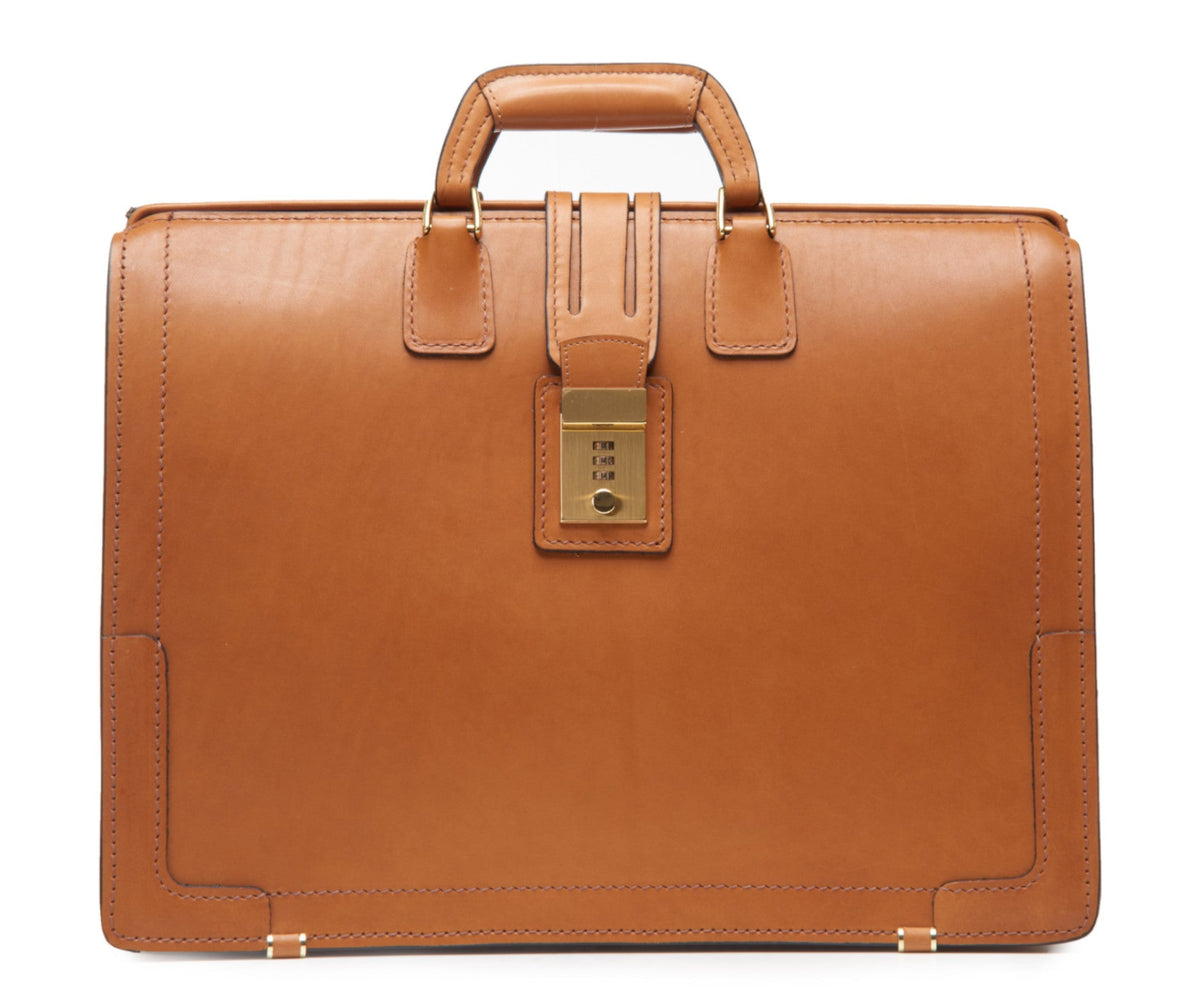
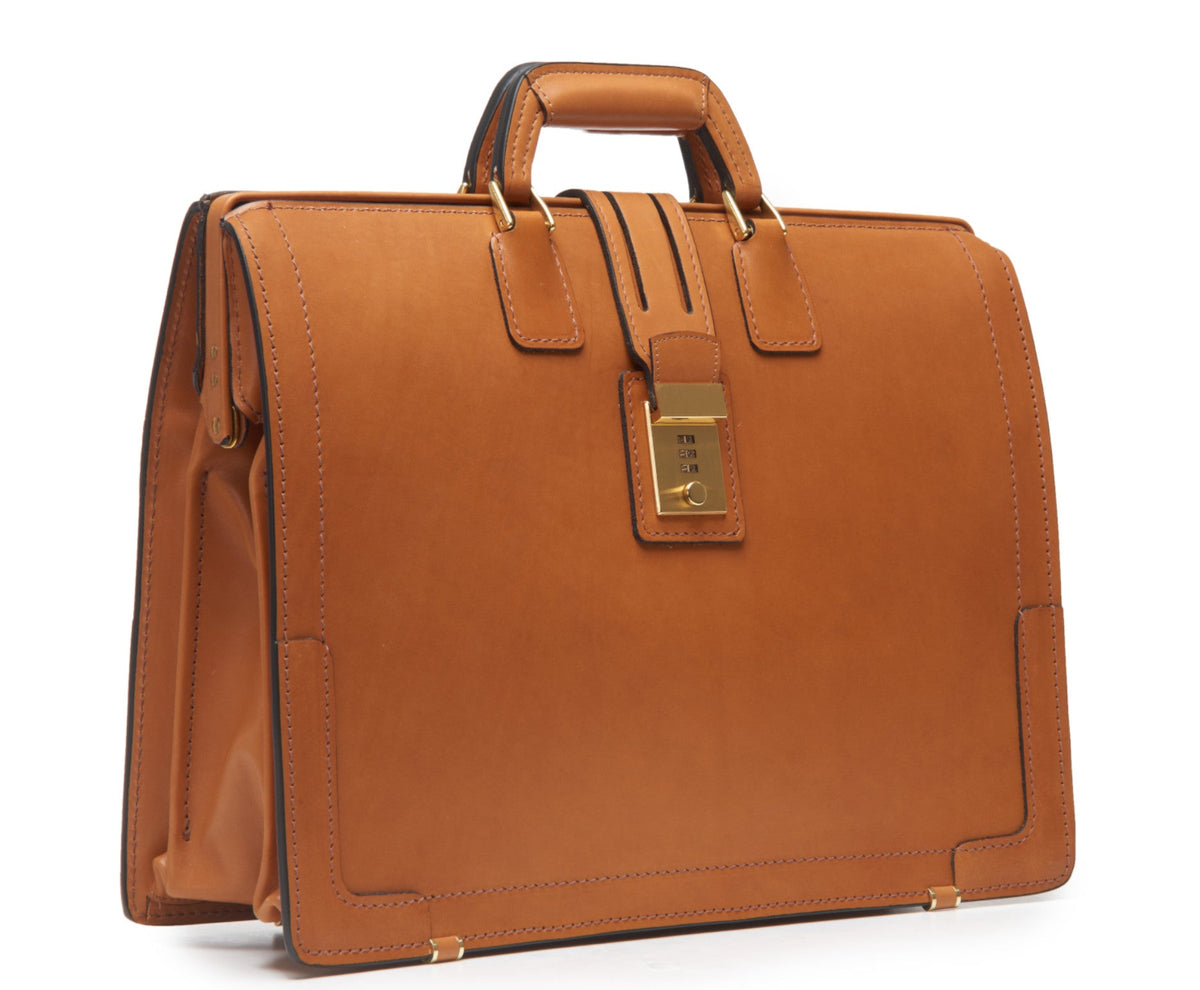
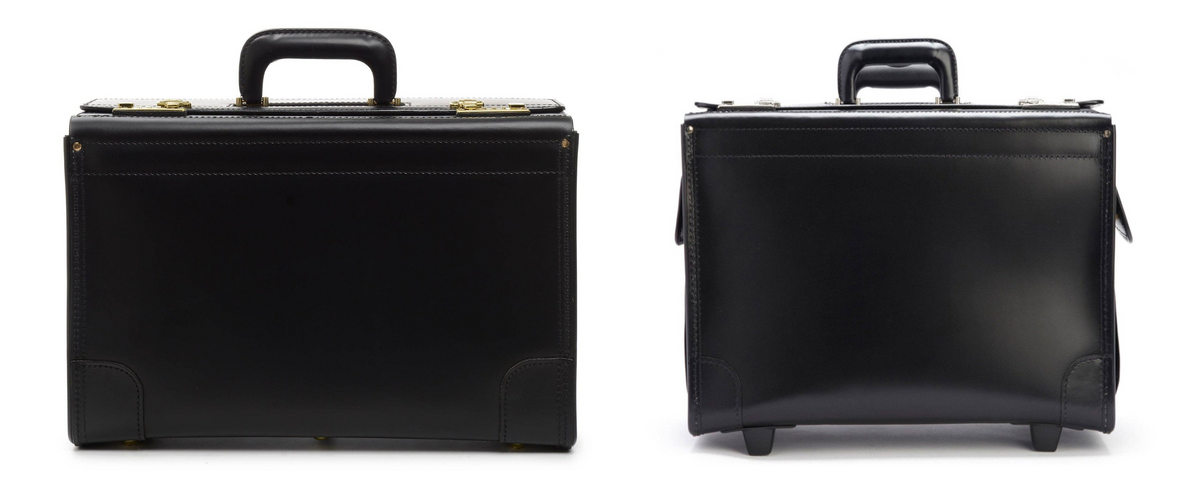
The Churchill is Korchmar's frame briefcase — full-grain leather, sourced in the USA and finished into the case in the Dominican Republic, over a rigid, arched top frame closed with Korchmar's patented Hinge-Loc™ system and finished in antiqued brass. It's the same hinged-frame lineage traced above, refined for a 17" laptop instead of a brief. Nothing about it tries to be modern — it's an excellent, historically literate version of what lawyers have carried since the Gladstone bag.
- AArched top frame — descendant of the 1826 hinge that made a rigid case possible in the first place.
- BHinge-Loc™ brass closure — swings the frame open flat rather than unzipping or unbuckling.
- CFull-grain leather, sourced in the USA — takes on its own patina rather than staying factory-new.
- DDedicated laptop sleeve and expandable compartments, sized for a 17" machine.
| Made by | Korchmar (Naples, FL) — made in the Dominican Republic |
|---|---|
| Silhouette | Rounded, traditional frame-top |
| Colors | Black, Tan |
| Best for | Chambers with a hundred years on the letterhead — or clients who'd notice if you didn't match them |
Exhibit B — The Silk
The same purpose. A different silhouette.
The Silk is our own briefcase, handcrafted in Kolkata, India — named for the moment a barrister "takes silk," the same rite of passage that once earned a junior the right to carry a red bag. Where the Churchill is a hinged frame built on nineteenth-century English engineering, the Silk draws on a different, no less storied tradition: India's leather craft long predates the Raj, and Kolkata has been a centre of it for generations.7 Full-grain, vegetable-tanned leather, solid brass hardware, a structured silhouette closed with a brass key-lock instead of a swinging frame, set on protective metal feet. Available in black or warm brown. Not a step up from the Churchill — a different answer to the same question.
- Incredible India (Ministry of Tourism, Government of India), Kanpur Saddlery, incredibleindia.gov.in (leather and saddlery trade established in Kanpur in the 1800s to supply the British Army and police, with East India Company craftsmen training local artisans; the region remains a recognized center of handcrafted leather production today). ↩
- ABrass key-lock — set into a structured flap rather than a hinge.
- BProtective metal feet — keeps the base off whatever surface it's set on.
- CFull-grain, vegetable-tanned leather — develops its own character; no two hides identical.
- DOrganized interior with a padded sleeve, sized for a standard laptop.
| Made by | Barrister & Bespoke, handcrafted in India |
|---|---|
| Silhouette | Structured, sleek, understated |
| Colors | Black, Warm Brown |
| Best for | Building a practice on your own name rather than someone else's |
The Spec Sheet
Side by side
Same purpose, different aesthetic — not a ladder, a fork in the road. The full comparison is above; the one detail worth adding here is hardware — the Churchill's antiqued brass fittings against the Silk's protective metal feet, each making the same case in a different accent.
The Docket
Which one, which room
Four moments, and the case for each briefcase.
Inherited chambers
The Churchill
Walls with a hundred years of case law bound in leather don't need to be argued with. Match them.
Founding your own practice
The Silk
Nothing in the room says you inherited anything. The case shouldn't either.
Meeting Commonwealth counsel
The Churchill
The frame case reads correctly the moment it's set on the table, wherever the table happens to be.
The partnership vote
The Silk
When the vote goes your way, the English Bar has a name for what just happened: you've taken silk. Carry the case named for the moment.
Closing Argument
A briefcase stopped announcing rank the moment it stopped being rare. What's left is judgment — proof that whoever carries it chose something on purpose, the way a silk once chose a bag for a junior. The Churchill and the Silk are both correct answers; neither is the safe one dressed up as the other. Choose the aesthetic that's actually yours, and you'll rarely choose wrong.
Shop BriefcasesMORE FROM THE FIELD GUIDE
Padfolio, or Portfolio?
Card Case, or Card Wallet?
Fine Nib, or Medium?
A Cigar, Counselor?
The Catalog Case: Hand Carry or Wheeled?
Season It, or Ruin It?
The Shirley, or the Camilla?
Fountain, Rollerball, or Ballpoint?

Written by James Kaywell