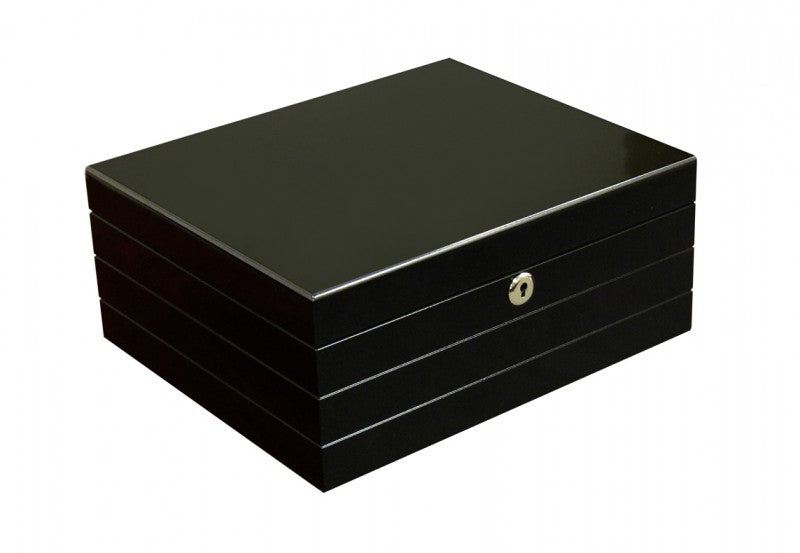
Article: Season It, or Ruin It?
Season It, or Ruin It?

Field Guide No. 07 · The Seasoning Brief
Season It,
or Ruin It?
How to season a new cigar humidor, and how to hold the climate once it is set.
Headnote
How to season a new cigar humidor
A new humidor must be seasoned before cigars go into it. Wipe the interior Spanish cedar with a cloth dampened in distilled water, soak the lid humidifier in distilled water and blot it dry, then close the humidor over a shallow open dish of distilled water for three to five days. Let it settle two to three days, then confirm the hygrometer holds steadily between 65% and 72% relative humidity at 65–70°F before loading cigars, and load them gradually over several days.
Use distilled water only. Tap, filtered and spring water all carry dissolved minerals that clog the humidifier and stain the cedar permanently. Calibrate the hygrometer with the salt test before trusting any reading: a saturated salt solution holds 75% RH, so a gauge reading 71% in that test runs four points low.
Applies to wood desktop humidors · Reviewed August 2026
A humidor arrives dry. Not defective — dry. The Spanish cedar left the workshop at whatever humidity the workshop held, spent weeks in a carton, and reached your door thirsty.
Put cigars in that afternoon and the cedar does what cedar does: it draws moisture from the nearest available source, which is now your cigars. This is the most common failure in the category and it is entirely avoidable.
It also explains the complaint under nearly every humidor sold online — it won't hold humidity — which is, in the great majority of cases, a seasoning problem rather than a manufacturing one. What follows costs a gallon of distilled water, a clean cloth, and the discipline to leave the box shut for three days.
The Standard, At a Glance
| Target | Why | |
|---|---|---|
| Relative humidity | 65–72% | Below 60% the oils go; above 72% mould and bacteria take hold |
| Temperature | 65–70°F | Beetles stay dormant; warm air holds more water |
| Water | Distilled only | Tap minerals stain cedar and clog the humidifier |
| Seasoning time | 48–72 hours | Long enough for the cedar to swell and the seal to close |
| Hygrometer calibration | 75% salt test | An untested gauge invites confidence it has not earned |
Exhibit A sets out the seasoning protocol. Exhibit B covers holding the climate once established. The Docket collects the four ways this goes wrong, Exhibit C tests the instrument you are relying on, and Questions Presented answers what buyers most often ask.


Exhibit A — Seasoning a New Humidor
Three days that decide the next thirty years.
How to season a humidor before first use
Seasoning brings the cedar up to humidity so it stops taking moisture from your cigars and begins holding it for them. The wood swells slightly as it absorbs, which is also what tightens the lid seal.
You need three things: a gallon of distilled water, a clean lint-free cloth, and a shallow open dish. Nothing else, and nothing clever. Do not sand the cedar, and do not use the wet-sponge-against-the-wall method that circulates online — soaking raw cedar warps it.
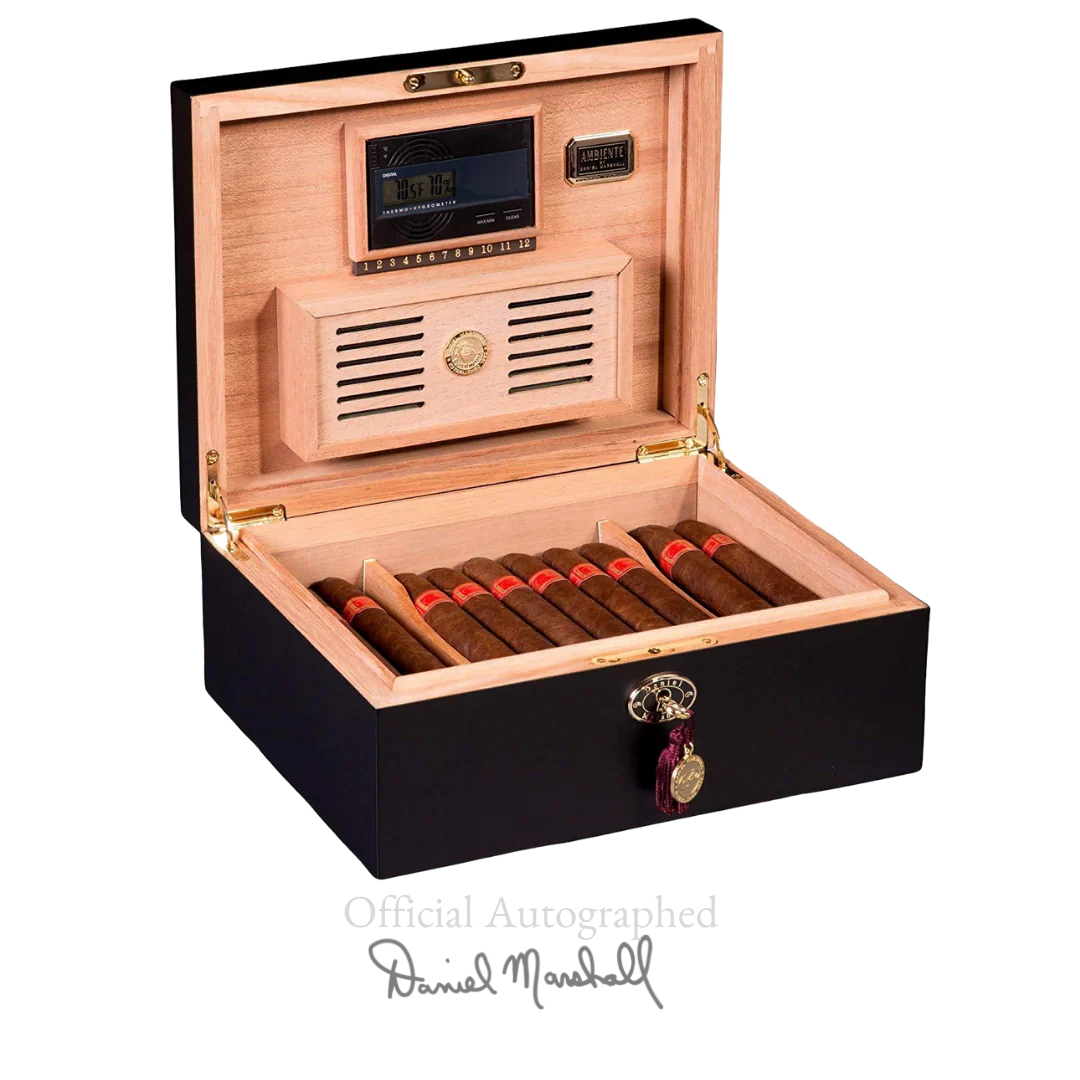
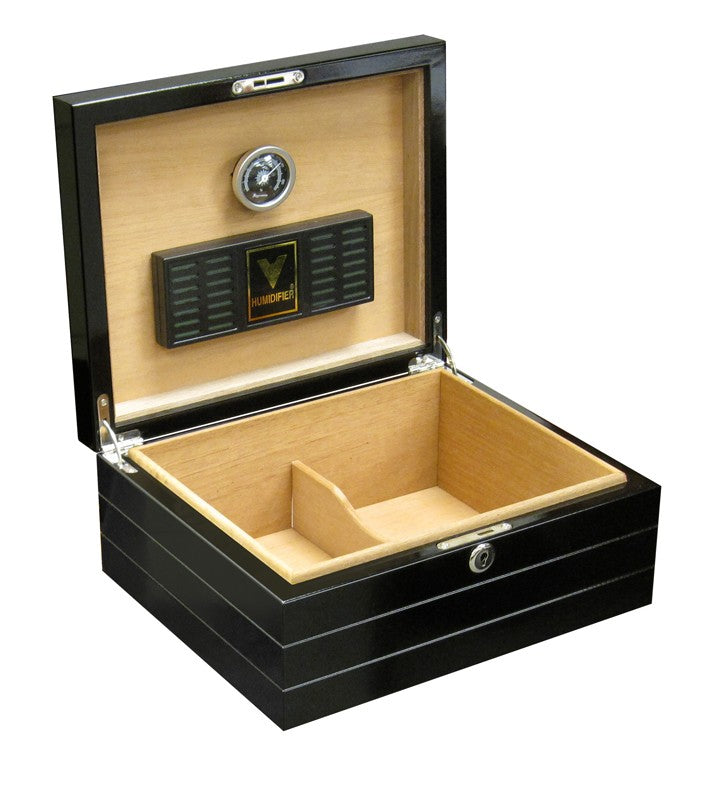
- AHumidifier — mounted in the lid. Charged by soaking, then blotted dry so nothing drips onto the cedar below.
- BSpanish cedar lining — the working surface. Wipe every face, including the underside of the lid and both sides of the divider.
- CThe dish — a shallow open vessel of distilled water, standing inside for the duration. It evaporates; you never pour water on the wood.
- DThe seal — not a latch. The fit of lid to body holds the climate, and it improves as the cedar swells.
-
Day one · 10 minutes
Wipe the cedar
Dampen the cloth with distilled water and wipe every interior surface — walls, floor, the underside of the lid, both faces of any divider, and the trays. Damp, never wet. If water beads on the surface you have used too much.
-
Day one · 5 minutes
Charge the humidifier
Remove the unit from the lid and soak it in distilled water for two to three minutes. Blot the exterior dry, then reseat it. A humidifier that drips will stain the cedar beneath it permanently.
-
Days one to five · leave it alone
Close it over water
Stand a small open dish of distilled water inside, close the lid, and leave the humidor undisturbed for three to five days. Resist opening it to check. Every opening resets the process and adds a day.
-
After the wait · 5 minutes
Verify before loading
Remove the dish. The reading will be high — typically 75% to 85% — and that is correct. Close the lid and leave it two to three days to settle until it holds steadily between 65% and 72%. If it settles below the band, close it over water again for another two days. A humidor that will not hold after a full week has a seal problem, not a seasoning problem — write to us.
-
Week one
Load gradually
Bring cigars in over several days rather than filling the humidor at once. A full load of drier cigars pulls the climate down faster than the humidifier can recover it, and you will spend a fortnight chasing the reading back up.
On Distilled Water
This is the one instruction here that admits no exception. Tap water carries dissolved minerals that clog the humidifier's pores, leave white deposits on the cedar, and can carry organic matter that bacteria and mould feed on. Spring and filtered water are not substitutes — filtration removes particulates, not dissolved solids. Distilled water runs about two dollars a gallon at any grocery store, and one gallon outlasts the first year.
Exhibit B — Holding the Climate
Stability beats precision.
What humidity should a cigar humidor be kept at?
Hold 65% to 72% relative humidity at 65–70°F. Within that band, stability matters more than the figure: a humidor sitting at 66% all year treats cigars better than one swinging between 60% and 75% while averaging a perfect 68%.
Cigars are hygroscopic — they take on and give up moisture with their surroundings — and it is the swinging, not the number, that splits wrappers and ruins burn.
Relative humidity is relative to temperature. Warm air holds substantially more water than cool air, so 65% in a 78°F Florida room is a materially wetter environment than 65% in a 62°F study. Keep the humidor off exterior walls, out of sunlight and away from vents.
- AToo dry — below about 60%, the oils that carry flavour evaporate and wrappers turn brittle.
- BThe band — 65% to 72%, the working range this catalog recommends.1
- CMould risk — above 72% mould and bacteria take hold, and at 72% with 72°F the beetle threshold opens. Treat 72% as a ceiling, not a target.2
- DThe needle — worth less than whether it has been calibrated. See Exhibit C.
| Recharge interval | Every 2–4 weeks; sooner in heated or air-conditioned rooms |
|---|---|
| Calibration | Before first use, then twice yearly |
| Rotation | Move cigars top to bottom every few months |
| Opening | Deliberately. Every opening resets the climate |
- Habanos S.A., Ageing Finished Cigars (official guidance; specifying 65–70% relative humidity at 16–18°C with adequate ventilation, the standard applied by Casa Habano retailers worldwide); Boveda, Protecting Your Cigars With Precision (product documentation; defining the safe cigar storage range as 65–72% RH, recommending 69% as an everyday target, and noting loss of essential oils below 60% RH). ↩
- On mould: Boveda, supra note 1 (identifying increased mould and bacterial risk above 72% RH). On beetles: Fighting Tobacco Beetles, Cigar Aficionado (larvae of Lasioderma serricorne hatch where relative humidity exceeds 72% and temperature exceeds 72°F simultaneously — the principal reason most authorities counsel holding at or below 70% RH, to preserve a margin from the threshold rather than to sit upon it). ↩
Building the Kit
Three ways to hold a climate
Distilled water, propylene glycol solution, or two-way humidity packets — what each does, and which suits which room.
Every humidor in this catalog ships with a humidifier fitted. What you charge it with, or whether you supplement it, is the decision that follows. A word on what we do and do not sell: Barrister & Bespoke carries humidors, not humidification consumables. Distilled water, propylene glycol solution and two-way packets are inexpensive, widely stocked, and better bought locally than shipped. We would rather tell you plainly what to buy than sell you a bottle at a markup.
Method I — As fitted
Distilled water
The humidifier already mounted in your lid, charged with distilled water alone. Costs almost nothing, works everywhere, and is what the manufacturer designed the unit around. Its limitation is that it only adds moisture — it cannot take any back out — so it needs watching in a humid room.
Best for stable indoor climates
Method II — The upgrade
Propylene glycol solution
A 50/50 blend of food-grade propylene glycol and distilled water, used in the same fitted humidifier. The glycol regulates more evenly than water alone and inhibits the bacterial growth that precedes mould. An eight-ounce bottle runs a desktop humidor most of a year.
Best for set-and-forget maintenance
Method III — Two-way
Humidity packets
Sealed packets calibrated to a fixed relative humidity that both release and absorb moisture, holding a set point without any charging at all. Sized by weight to humidor volume, and replaced when they stiffen rather than refilled. They may be used alongside the fitted humidifier or instead of it.
Best for travel cases and humid climates
A Note on Packet Sizing
Two-way packets are sold both by weight and by target humidity. Match the target to the band above — a 69% packet sits squarely inside the working range, and 72% sits on its ceiling; anything advertised at 75% or higher does not. On quantity, the maker's own baseline is one 60-gram packet for every 25 cigars of capacity, which puts a 50-count desktop humidor at two 60-gram packets. Undersized packets exhaust quickly and give you the worst of both approaches.
The Docket
Four ways humidor seasoning goes wrong
Every one of these is common, and every one is recoverable if caught early.
Count I
Tap water
The most frequent error and the most avoidable. Dissolved minerals clog the humidifier and leave permanent white deposits on the cedar. Filtered and spring water are not substitutes — distilled, or nothing.
Count II
The untested gauge
Most analog hygrometers ship uncalibrated and can read five points or more off true. A gauge you have not tested is not a measurement; it is a reassurance. Exhibit C, below.
Count III
Over-humidifying
More is not better. Above roughly 72% cigars swell, draw tight, burn unevenly and turn vulnerable to mould. The instinct to push the number higher after a dry spell is the instinct to resist.
Count IV
Mould, mistaken for plume
Plume, or bloom, is a fine white crystalline dust that wipes away cleanly and is harmless — a sign of good ageing. Mould is fuzzy, raised, spotted and often blue-green. Plume you admire; mould you remove, immediately and entirely.
Exhibit C — Calibrating the Hygrometer
Test the witness before you rely on the testimony.
How to calibrate a hygrometer using the salt test
A saturated salt solution holds the air above it at 75% relative humidity at ordinary room temperature. That holds to within a few tenths of a point across ordinary room temperatures, which makes common table salt a free and genuinely reliable reference standard.3
Fill a bottle cap with table salt and add a few drops of distilled water — enough to dampen the salt thoroughly, not enough to dissolve it into a pool. Seal the cap and the hygrometer together in a zip-top bag, keeping them from touching, and leave them 24 hours at steady room temperature.
A correct instrument reads 75%. If yours reads 71%, it runs four points low: adjust it if it adjusts, and if it does not, write the offset on tape inside the lid and read accordingly. An analog gauge four points off but known is more useful than a digital one that is perfect but untested.
- ASealed bag — an ordinary zip-top will do. The seal matters; the bag is only holding a stable volume of air.
- BDamp salt — thoroughly wetted but not dissolved. If it has slumped into brine, start again with less water.
- CThe reading — taken at 24 hours, without opening the bag. Anything other than 75% is your offset.
- The saturated salt (NaCl) method is a recognised humidity reference: see ASTM E104, Standard Practice for Maintaining Constant Relative Humidity by Means of Aqueous Solutions (listing sodium chloride at 75.3% RH at 25°C); Greenspan, Humidity Fixed Points of Binary Saturated Aqueous Solutions, 81A J. Res. Nat'l Bureau of Standards 89 (1977). The value drifts slightly with temperature, which is why the test should be run somewhere thermally steady rather than on a windowsill. ↩
Questions Presented
The eight asked most often
Answered directly, in the order buyers tend to ask them.
How do you season a new humidor?
Wipe the interior Spanish cedar with a cloth dampened in distilled water, soak the lid humidifier in distilled water and blot it dry, then close the humidor over a shallow open dish of distilled water for three to five days. Let it settle two to three days, then confirm the hygrometer holds between 65% and 72% before loading cigars.
How long does it take to season a humidor?
three to five days for a standard wood desktop humidor. Larger cabinet and multi-drawer humidors often need a second cycle of another 24 hours. Load cigars gradually over the following several days rather than all at once.
What humidity should a cigar humidor be kept at?
65% to 72% relative humidity at 65–70°F. Habanos S.A. specifies 65–70% for ageing finished cigars; Boveda defines the safe range as 65–72%. Stability within that band matters more than any single figure.
Can you use tap water in a humidor?
No. Tap water carries dissolved minerals that clog the humidifier, leave permanent white deposits on the cedar, and can carry organic matter that bacteria and mould feed on. Filtered and spring water are not substitutes, since filtration removes particulates rather than dissolved solids.
Why will my humidor not hold humidity?
Most often because it was never seasoned — dry cedar absorbs moisture faster than the humidifier supplies it. The second most common cause is an uncalibrated hygrometer reading several points off true. A genuine seal failure is the least common of the three.
How do you calibrate a hygrometer with salt?
Seal the hygrometer in a zip-top bag with a bottle cap of table salt dampened by a few drops of distilled water, and leave it 24 hours. A correct instrument reads 75%; any difference is the gauge's offset.
Do you still need to season a humidor if you use two-way packets?
Yes. Two-way packets hold a set point but carry a finite moisture reserve, and unseasoned cedar will exhaust them quickly. Season with distilled water first, then introduce packets to maintain the climate you have established.
What is the difference between mould and plume on a cigar?
Treat any doubtful white growth as mould. Plume, or bloom, is a fine crystalline dust said to accompany good ageing, but it is not reliably told apart from mould by eye — both can wipe away, and cigar mould is more often white and powdery than blue-green. Remove affected cigars immediately, wipe the interior down, and inspect the rest.
Closing Argument
Distilled water, a calibrated gauge, and the patience to leave the box shut for three days before you use it. That is the entire case. Do those three things at the outset and a well-built humidor will hold its climate for decades — long enough to outlast the practice you bought it to celebrate, and to be handed on to someone who will need it explained all over again.
Shop the HumidorsMORE FROM THE FIELD GUIDE
Padfolio, or Portfolio?
Card Case, or Card Wallet?
Fine Nib, or Medium?
A Cigar, Counselor?
The Churchill, or the Silk?
The Catalog Case: Hand Carry or Wheeled?
The Shirley, or the Camilla?
Fountain, Rollerball, or Ballpoint?

Written by James Kaywell